DTF vs Screen Printing: Which Printing Method Fits Your Business?

Ask a print shop "DTF or screen printing?" and you will hear confident answers on both sides. The reason is simple: there is no universally correct choice. DTF (direct-to-film) and screen printing solve different problems, and the shops that grow fastest stop treating them as rivals.
The short version: DTF prints full-color, detailed, or photographic artwork with no screens and no minimum order, which makes it the natural fit for small runs, samples, and print-on-demand. Screen printing pushes ink through a mesh screen and is hard to beat on cost per piece once you are running hundreds or thousands of identical garments. But that summary hides two things most comparison articles skip: the break-even point between the two moves with your order mix, and the quality of your materials can flip the conclusion either way.
This guide walks through the real cost logic, why material quality matters more than the method itself, and a decision framework you can apply to your own order book. It is written for print shop owners, POD sellers, and production managers comparing the two.
1. DTF vs Screen Printing at a Glance
A quick reference before the detail. Treat the entries as directional — real results depend on material quality, equipment, and how each job is set up.
| Factor | DTF (Direct-to-Film) | Screen Printing |
|---|---|---|
| Design / colors | Full color, gradients, and photos in one pass | One screen per color; strongest on simple designs |
| Minimum order | None — single pieces are practical | Screen setup makes very small runs expensive per piece |
| Setup | Print-and-press, no screens | Screens must be made and registered per color |
| Cost shape | Per-piece cost stays relatively flat | High first piece, then per-piece drops sharply |
| Fabric range | Cotton, polyester, blends, and more | Strong on cotton; synthetics may need special inks |
| Hand feel | Softer, thinner, more flexible | Thicker ink deposit, more textured |
| Durability | Good when pressed and cured correctly | Long track record, especially on cotton |
| Turnaround | Fast — no screen prep | Slower due to screen setup |
2. How the Two Processes Actually Work
DTF is a print-and-press workflow: a design is printed onto a PET film, coated with hot-melt powder, cured, then heat-pressed onto the garment. Screen printing is a stencil workflow: ink is pushed through a mesh screen, one color at a time, then cured with heat.
That single difference — DTF moves the complexity into printing, screen printing moves it into screen setup — explains most of the trade-offs that follow. We will keep the process background brief here, since the decision that matters is economic and material, not procedural.
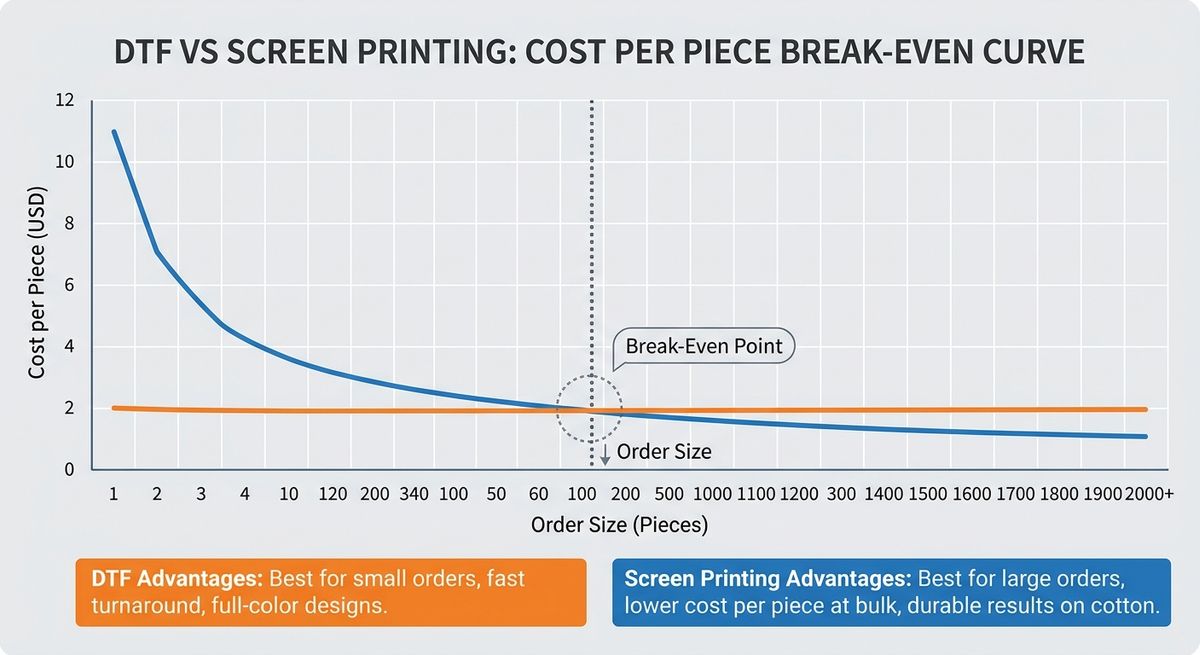
3. The Real Cost Difference — and Why the Break-Even Point Moves
The common line is "DTF for small runs, screen printing for bulk." That is right, but it is more useful to understand why, because the crossover point is not a fixed number.
Screen printing's cost is front-loaded. Each color needs its own screen, and each screen is a setup cost you pay before the first garment is printed. Once the screens exist, the marginal cost of each additional shirt is low — mostly ink and press time. The first shirt in a run is expensive; every shirt after it gets cheaper on average.
DTF's cost is per-piece. There is no screen to make, but every transfer consumes film and powder, and every print still needs press time. The cost per piece stays relatively flat whether you print one shirt or fifty.
That structure means the break-even point moves with three things:
Number of colors. A one- or two-color design has low screen setup cost, so screen printing can win at modest volumes. A six- or eight-color design multiplies the screen cost and pushes the crossover to a much higher quantity — while DTF prints all of those colors in one pass.
Batch size. Small batches never amortize the screen cost, so DTF wins cleanly. Large identical runs amortize it almost to zero, so screen printing wins on unit cost.
Design changes. Every design variation in screen printing means a new set of screens. Printing 30 different player names is 30 setups. DTF prints each one without additional setup.
The practical point: do not memorize a crossover number. Model your own order mix against the setup and per-piece costs you actually pay, because both vary by supplier, region, and design.
4. Why Material Quality Can Flip the DTF-vs-Screen Answer
Most comparisons stop at the method level. But two shops running "DTF" can get very different results, because the method is only half the story.
A DTF transfer is only as good as its film, powder, and ink. The film's coating determines how cleanly ink is held and released. The powder's particle size and how evenly it cures determine how the design bonds and flexes. The ink must match the film and powder, or you get wash-down problems, weak white opacity, or a stiff hand feel. Cheap film with an uneven coating, or powder that cures inconsistently, produces exactly the failures people wrongly attribute to "DTF as a method" — banding, poor wash fastness, and a plasticky feel.
Screen printing has the same dependency on its own materials. Mesh count controls how much ink is deposited and how fine the detail can be. The ink system matters too: plastisol inks give a thicker, more opaque deposit with a distinct hand, while water-based inks feel softer but can be less opaque on dark fabric. Cure temperature and dwell affect wash durability just as much as the ink itself.
The takeaway is not that one method is more reliable. It is that a well-executed screen print can outperform a badly executed DTF transfer, and a well-executed DTF transfer can outperform a sloppy screen run. If you are choosing a DTF film for the first time, compare a specific film-powder-ink combination against a specific screen-ink combination — not two abstract labels.
5. Batch-to-Batch Consistency — the Hidden Cost
For a business that runs repeat orders, consistency matters as much as any single spec, and it cuts across both methods.
DTF film and powder can vary between batches. If the coating absorbs ink differently from one roll to the next, or the powder behaves differently, your press settings, cure time, and powder application all need re-tuning — and every re-tune is downtime and test waste. Screen printing has a similar issue with ink batches and screen tension, though its variables are often more controllable once the process is dialed in.
This is the consideration most consumer-facing guides skip, and it is the one that costs a scaling business the most. Ask your supplier how they control batch consistency — whether they test coating uniformity, powder particle size, and ink behavior across batches. A slightly more expensive material that runs consistently is usually cheaper than a cheap one that forces you to re-validate every delivery.
6. How to Choose Based on Your Orders — a Decision Framework
Instead of asking "which is better," ask "what do my orders actually look like?" Four variables do most of the work: design complexity, batch size, fabric mix, and turnaround.
| Situation | Usually the better fit |
|---|---|
| Full-color, gradients, photographic detail | DTF |
| Simple one- or two-color text or logos | Screen printing at volume; DTF for small runs |
| Small batches, samples, one-offs | DTF |
| Large identical runs (hundreds or more) | Screen printing |
| Mixed fabrics (cotton + polyester + nylon) | DTF |
| Frequent design changes or personalization | DTF |
| Specialty inks (metallic, puff, glow) | Screen printing |
| Fast turnaround, no inventory | DTF |
A few notes on how to read it. "Full color" and "small batches" point strongly toward DTF, because screen printing charges for every color and every setup. "Large identical runs" points toward screen printing, because that is where its front-loaded cost finally pays off. And if your order book mixes both — as most shops' does — you are not choosing once and for all; you are choosing per job.
If you want to test the water without investing in a printer, you can order ready-to-press DTF transfers and press them on your existing equipment — a common first step for shops adding full-color capability.
7. When to Run Both (Hybrid)
The best-known answer in apparel decoration is often "both." Two patterns show up repeatedly.
Split by job type. Run full-color front graphics as DTF transfers, and simple names, numbers, or single-color backs as screen prints. Each method does the part it is strong at.
Split by volume. Use DTF for samples, prototypes, and short runs so you never turn down a small order, and screen printing for the bulk reorders that make your margin.
There is also a practical sourcing angle: if you run both, buying film, powder, and screen-printing consumables from one supplier keeps your material specs consistent and simplifies reordering. A supplier that stocks both sides can usually help you match materials to the same production workflow.
Conclusion
DTF and screen printing are not competing answers to the same question. DTF wins on full-color detail, small runs, fabric range, and speed. Screen printing wins on unit cost for large, simple, identical runs and on specialty inks. The shops that profit most match the method to the order — and hold their materials to a standard, because a great method with poor materials is still a poor result.
If you are comparing the two for your own workflow, start small: run one design through each and compare cost, feel, and durability against your real requirements. If you are sourcing DTF materials, pay attention to film coating, powder consistency, and ink compatibility before you scale. LorinTransfer supplies DTF film and related transfer materials — request a sample or contact us to discuss your requirements.
FAQ
Is DTF cheaper than screen printing?
Does DTF last as long as screen printing?
Can DTF print as many colors as screen printing?
What is the minimum order for DTF vs screen printing?
Which is better for a small business?
Contact Us
Tell us your requirements and our team will get back to you within 24 hours.

Ellen Lin
Product Manager & Heat Transfer Materials Specialist
Ellen Lin is a Product Manager at LorinTransfer, specializing in heat transfer materials, DTF printing solutions, and UV DTF transfer products. With hands-on experience in product development and market research, Ellen works closely with manufacturing teams and printing professionals to improve product performance, application methods, and customer solutions. She shares insights on transfer printing technologies, material selection, and industry trends to help businesses make better decisions for their printing projects.
Related Articles
DTF Printing on Dark Fabrics: Isolate the Cause Before You Adjust Settings
A faded print on a black shirt usually gets worked on in one of two places: the heat press, or the white ink settings in the RIP.
DTF Transfers for Print on Demand: A POD Seller’s Sourcing Guide
There is a moment in the life of almost every custom apparel store when the numbers quietly stop working. Orders arrive, designs sell — and the fulfillment receipt still shows you keeping five to eight dollars on a twenty-five dollar shirt.

What DTF Film Can Your Printer Run? Matching Specs by Machine Class
Few purchases fail as quietly as the wrong roll of DTF film. It arrives on schedule, wound neatly on its core, exactly the width the product page advertised — and it does not fit the machine it was bought for.