DTF PET Film Explained: Structure, Types & Buying Guide

Almost every DTF film listing you open says the same thing in the spec line: PET. Few buyers know what those three letters stand for, what sits on top of the film, or why two rolls that look identical behave so differently at the press.
That gap costs money. Film choice shapes how sharp a print resolves, how evenly powder sticks, how cleanly the carrier peels, and how the finished transfer holds up in wear. Ink and powder get most of the attention. The film underneath sets the ceiling for both.
We coat DTF film in Xiamen and ship rolls and sheets to print shops across the US and EU. This guide covers what the material is, how it is built, what the options actually change, and how to choose a film for your printer and your workflow.
Key Takeaways
DTF PET film is a clear PET base with a release layer and an ink-receiving coating. The coating decides how ink settles and how powder grips.
PET and polyester are the same polymer family. In film form it is a sheet; in fiber form it becomes polyester fabric.
75 µm is the standard thickness. Most buying decisions come down to peel style, single or double-sided construction, finish, and format.
Coating consistency shows up as even fills, steady powder pickup, and repeatable peels. Weak film shows the opposite.
Run a sample on your own printer, ink, and powder before you commit to volume.
What Is DTF PET Film?
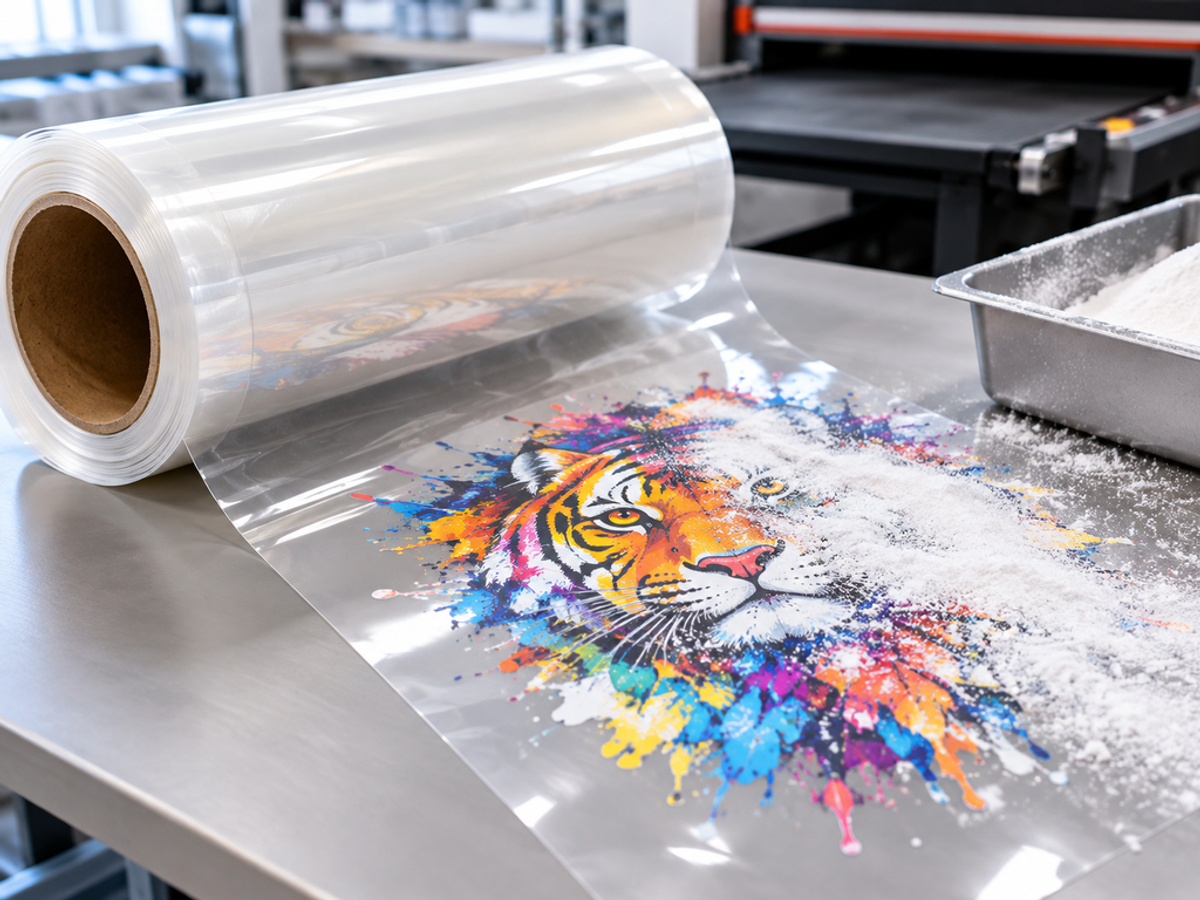
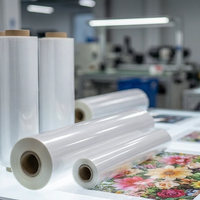
DTF PET film is a clear film made from polyethylene terephthalate, coated on the print side so it can hold DTF pigment ink and release a printed transfer under heat.
PET earns its place for two reasons. It is heat-stabilized, so it stays dimensionally stable under a heat press and the printed image does not stretch or distort before the powder layer bonds. And it holds its shape as it travels through a printer, which keeps the print flat and the feed reliable.
The material is also behind the most common confusion we hear. Buyers ask whether polyester film is the same thing as PET. It is, and it is not. PET is the polymer. Stretch that polymer into fiber and you get polyester fabric. Cast it into a thin sheet and you get PET film, which many suppliers call polyester film.
Same chemistry, different form, very different behavior. A polyester shirt is soft and porous. A PET film is a solid, stable sheet built to carry ink and then let go of it on command.
One point clears up a lot of confusion for new buyers: the film does not stay on the garment. It is a temporary carrier. Ink and powder land on it, the press melts the powder into the fabric, and the film leaves. What stays behind is a thin, flexible layer of pigment bonded to the cloth.
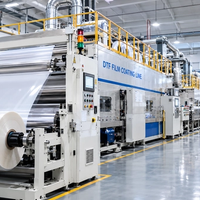
How DTF Film Is Made on Our Coating Line
We coat DTF film in Xiamen, and the line runs in a fixed order. Each step exists to make the next one predictable.
Base inspection. We unwind the PET base and check gauge consistency, haze, and surface defects. A flaw in the base becomes a flaw in the coating.
Coating. The release layer and the ink-receiving coating are applied in sequence, with the ink-side layer going on in a controlled thickness. This is the step that decides how the film performs at the printer and at the press.
Drying and curing. The coated film passes through drying and curing so the coating sets into a stable surface instead of a tacky one.
Slitting. Wide jumbo rolls are cut to finished widths, then trimmed to length for rolls or cut into sheets.
Quality control. We check coating coverage, adhesion, and how the film handles through a short print run.
Packing. Finished rolls and sheets go into moisture-resistant packing for export.
That is the general shape of the process. The specific settings on each step are ours, and we don't publish them. What matters for a buyer is the order: the base is inspected first, the coating is applied next, and everything after that protects what the coating already did.
The Layer Structure, Explained
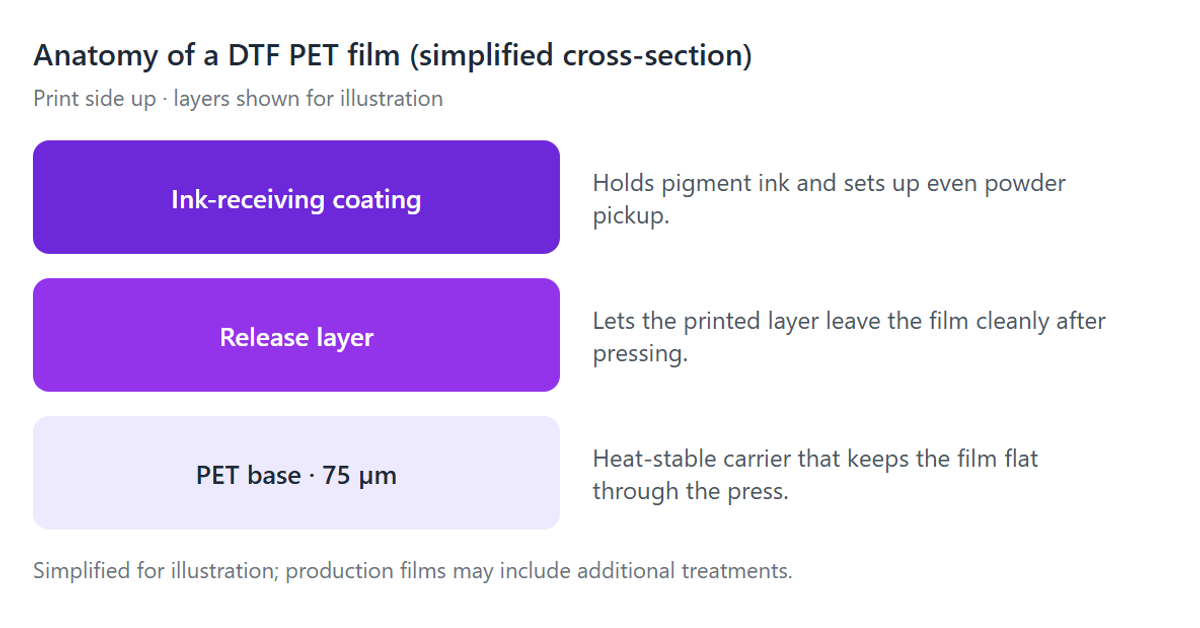
A working DTF film carries three layers, and each one has a job. This is a simplified view of the cross section, since real constructions vary by supplier and by product line.
Ink-receiving coating. The top layer takes the pigment ink and holds it in place long enough for powder to land. It controls how quickly the coating absorbs ink, how evenly dots spread, and how much of the white underbase stays where the printer put it.
Release layer. Under the coating sits a release layer. It keeps the printed image attached to the film through printing and powdering, then lets go in one clean motion when the transfer is pressed.
PET base. The 75 µm carrier gives the whole stack its structure. It carries the coating through the printer, takes the heat of the press, and stays flat so the image does not shift.
Read the stack from the top down and the logic is clear. The base provides stability. The release layer controls when the image lets go. The coating does the fine work, because it is the only layer that touches both the ink and the powder. That is why coating quality decides print quality more than any other part of the film.
Types and Specs: What Actually Differs
Most DTF film on the market is built on a PET base and looks similar in the box. The differences that matter are the ones you can specify: thickness, sides, peel behavior, finish, and format.
Thickness. 75 µm is the standard gauge, and it suits most shops. Thinner film feels lighter in the hand after pressing but can be fussier to feed on some machines. Thicker film feeds with more rigidity and resists curling, though it can stiffen the finished print. If your work is detail-heavy, test a sample before you settle on a gauge.
Single or double-sided. Single-sided film carries a matte treatment on one face. Double-sided film applies that matte treatment to both faces, which helps with anti-static behavior and keeps film from sticking to itself when powder is in the air. Shops running a powder shaker tend to prefer the double-sided construction.
Peel style. Hot, warm, cold, and instant peel films differ in when the carrier comes away from the pressed transfer. Hot and instant peel suit fast production. Warm peel gives a short pause. Cold peel suits dense art and heavy ink coverage. Our guide to hot peel vs cold peel films covers the timing trade-offs.
Finish. Matte and glossy refer to the film surface and how the pressed transfer reads. Glossy tends to hold brighter contrast. Matte tends to read softer on large solid areas. Matte vs glossy finishes goes deeper on which to stock.
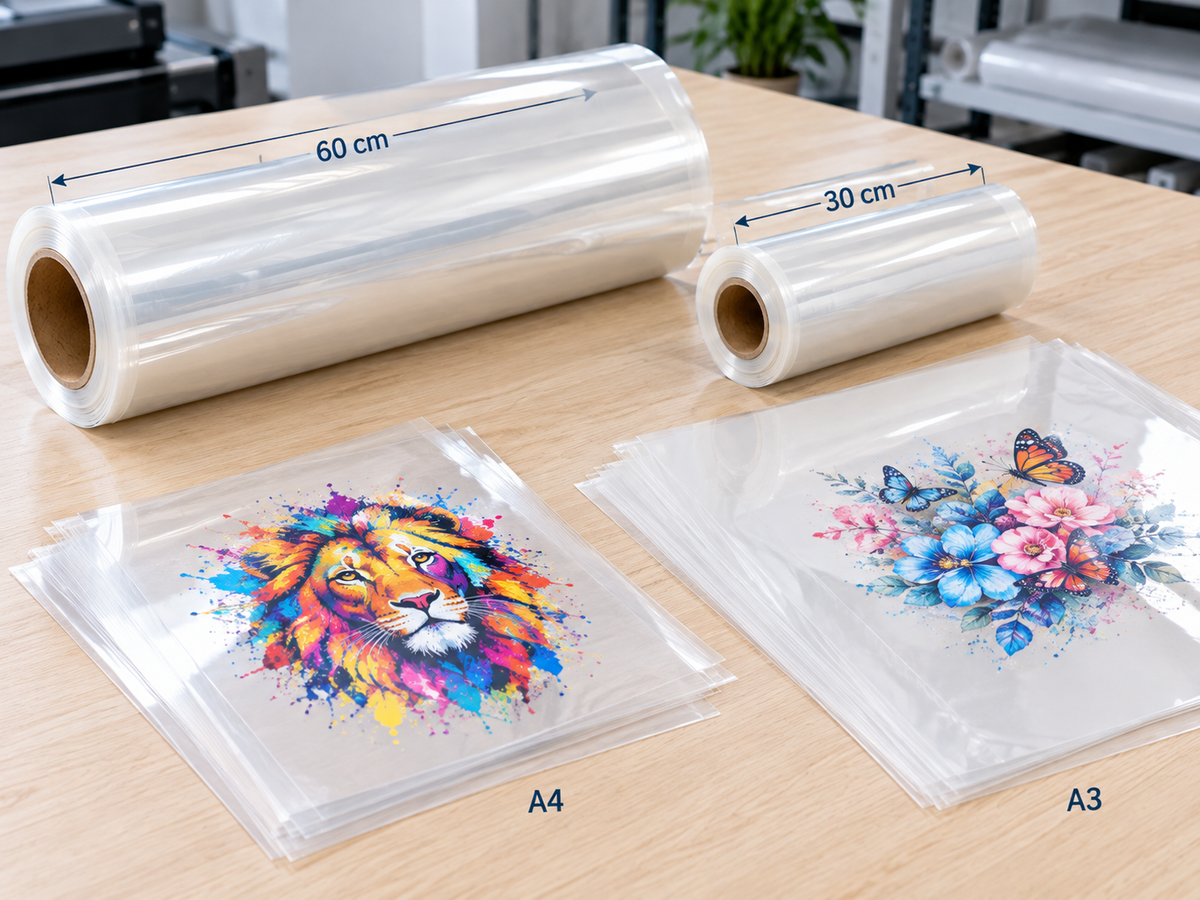
Format. Rolls come in 30 cm and 60 cm widths at 100 m each. Sheets come in A3, A4, and 13×19 inch packs for smaller jobs and desktop printers.
Ask for the specification in writing before you compare anything else. A useful spec sheet states thickness, width, length, side construction, peel style, and finish. Two suppliers quoting what looks like the same film can still be selling different products, and the spec sheet is how you find out.
| Option | What it means | Best for |
|---|---|---|
| 75 µm thickness | The standard gauge we run | Most shops and most jobs |
| Single-sided | Coating on one face only | Controlled powder stations |
| Double-sided | Matte treatment on both faces | Anti-static handling and cleaner powder pickup |
| Hot peel | Carrier comes off while the transfer is warm | Fast production runs |
| Warm peel | A short pause before peeling | Shops that want timing margin |
| Cold peel | Peel once the transfer has cooled | Dense art and heavy ink coverage |
| Instant peel | Peel immediately after pressing | Maximum throughput, minimal wait |
| Matte finish | Low-sheen surface on the pressed transfer | Large solid areas |
| Glossy finish | Smooth, reflective surface | Bright graphics and fine detail |
| Rolls | 30 cm and 60 cm widths, 100 m each | Volume printing |
| Sheets | A3, A4, and 13×19 inch | Small jobs, testing, desktop printers |
Why Coating Quality Decides Your Prints
Film quality is mostly coating quality, and coating quality shows up in four places.
Ink absorption uniformity. The coating has to take ink at the same rate across the full width of the roll. When it does not, solid fills come out mottled and gradients band.
Powder adhesion. Powder sticks to wet ink. If the coating lets ink sit too deep or dry too fast, powder has less to grab and the transfer loses covering power.
Peel consistency. The release layer and the coating have to work as a pair. A transfer that peels cleanly on one panel and tears on the next usually points to a coating issue, not a press issue.
Curl and static. Uneven coating and drying leave film that curls at the edges or clings to itself. That becomes a feeding problem before it is ever a print problem.
In our quality checks, weak film tends to announce itself early: mottled fills, powder dropout in solid areas, curled edges off the roll, and peels that change from sheet to sheet. When a shop sends us one of those symptoms, we usually start with the film batch. Our guide to DTF transfer problems walks through the diagnosis in more detail.
Consistency across batches matters as much as the first roll you receive. When coating shifts from delivery to delivery, you end up retuning printer and press settings on stock you already paid for, and that time never appears on an invoice. Ask any supplier how they hold a coating formula steady, and listen to the answer.
Storage and Handling
PET film is stable, but the coating is the sensitive part. A few habits keep it working the way it did when it left the line.
Keep film in its original wrap until you load it. The wrap keeps moisture and dust off the coating, and it does that job better than an open shelf.
Store away from direct sun, radiators, and heat sources. Coated film left in a hot vehicle or against a sunny window can pick up curl that never fully comes out.
Let rolls acclimatize before a long run. Film that has just come off a cold truck or out of a hot warehouse feeds differently from film that has sat in your shop for a day.
Use the oldest stock first. Rotate your film the way a kitchen rotates produce, so nothing sits at the back of the shelf through several seasons.
Stand rolls upright or lay them flat on a clean surface. Do not stack heavy cartons on top of film, and do not leave a partly used sheet out where powder dust and grit can settle on the coating.
Keep film and powder apart until you need both. Powder is meant for the wet print, not for the film stack, and a dusty sheet is a coating problem you created yourself.
How to Choose: A Buyer's Checklist
You do not need to memorize polymer chemistry to buy well. You need five checks.
Match the full set. Film, ink, and powder are designed to work as a set. Start with DTF film and printer compatibility and DTF ink and powder, explained.
Pick peel style by workflow, not by preference. Fast shops doing simple work do well with hot or instant peel. Shops printing dense art should lean cold.
Pick width by volume. 30 cm rolls suit narrow printers and short runs. 60 cm rolls cut waste on wide work. Sheets cover sampling and small orders.
Test before you scale. Run a sample on your printer, with your ink and your powder, before you order cartons. A film that performs on someone else's line can behave differently on yours.
Ask for a quote in writing. Pricing is quote-based, because width, thickness, coating, and quantity all move the number. Tell the supplier what you print and how much, then get the terms on paper.
If you are still narrowing down which film suits your shop, choosing the right DTF film takes the decision one step further. When you are ready to price volume, sourcing DTF film in bulk covers cartons, pallets, and order handling.
Bottom Line
DTF PET film is a simple product with a demanding coating. The PET base gives you stability under heat. The release layer controls how the transfer lets go. The coating decides how well ink sits, how evenly powder grips, and whether your peels repeat from one sheet to the next.
Most buying decisions are simpler than they look. Choose 75 µm unless your work says otherwise. Choose peel style by workflow. Choose width by volume. Choose double-sided if static and powder handling are daily problems. Then test before you scale.
To request a sample and a quote, tell us your printer, ink, powder, and the formats you need. We will send film that matches your setup and quote it in writing.
FAQ
Is Polyester Film the Same as PET?
How Much Does a DTF Film Roll Cost?
What Thickness Is Best for Fine Detail?
Why Choose Double-Sided Film?
Will Any DTF Film Work With My Printer?
Contact Us
Tell us your requirements and our team will get back to you within 24 hours.

Ellen Lin
Product Manager & Heat Transfer Materials Specialist
Ellen Lin is a Product Manager at LorinTransfer, specializing in heat transfer materials, DTF printing solutions, and UV DTF transfer products. With hands-on experience in product development and market research, Ellen works closely with manufacturing teams and printing professionals to improve product performance, application methods, and customer solutions. She shares insights on transfer printing technologies, material selection, and industry trends to help businesses make better decisions for their printing projects.
Related Articles
Can You Use DTF Film in a Sublimation Printer? Honest Answer
You already own a sublimation printer. A customer wants a vivid print on a black cotton tee, and you want to know whether direct-to-film (DTF) film can get you there without a second machine.
Glitter & Specialty DTF Films: Types, Uses & Buying Guide
Glitter DTF film pulls about 170 US searches a month. Glow-in-the-dark follows at 90, and reflective at 50 (Lorin Transfer keyword research, Google Ads data, Oct 2026).
How to Source DTF Film Wholesale: A 2026 Buyer's Playbook
You're printing more DTF than ever, your film bill keeps growing, and the quotes you get from resellers all start to look the same — marked up 30% or more over