How Long Do DTF Transfers Last, and What the Wash Count Is Measuring

Two film data sheets, same product category, different suppliers. The first states 50 washes. The second states 80. A third, sold into the same market, goes past 100.
None of them says what a wash was. None states the water temperature, the detergent, the drying method, or — the part that decides everything — the point at which someone looked at the print and decided it had failed.
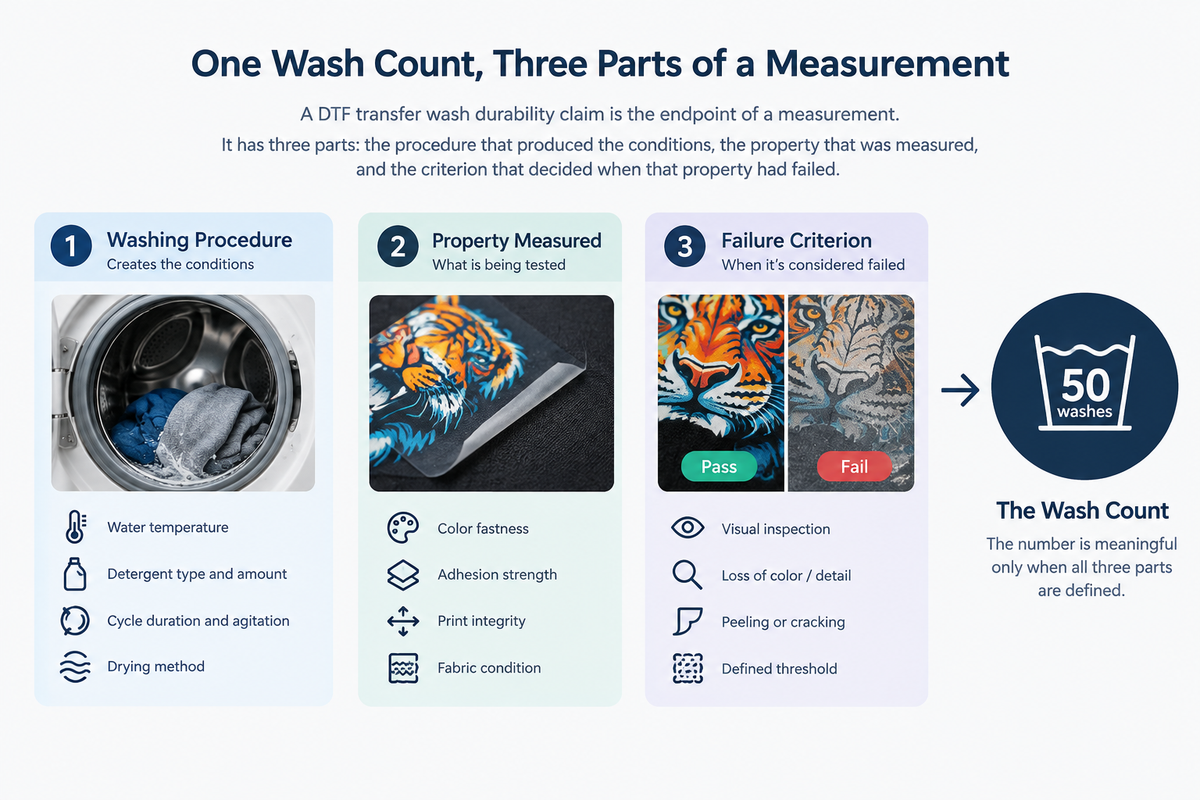
That omission is not a trick. It reflects how this industry talks about durability: as a single number attached to a product. But a wash count is not an attribute in the way thickness or width is. A DTF transfer wash durability claim is the endpoint of a measurement. A measurement has three parts: the procedure that produced the conditions, the property that was measured, and the criterion that decided when that property had failed.
Give only the endpoint, and you have said almost nothing. Two suppliers can quote 50 and 80 and both be accurate, because they are not describing the same measurement.
In practice, published DTF durability claims often range from roughly 40 to 100+ washes, but that number is only meaningful when the test conditions and failure criterion are stated.
This article takes the claim apart — what a wash cycle does to a transfer, why the numbers diverge, how failure gets judged, why home and industrial laundering are separate worlds with separate standards, and what to ask for so that the number you receive is one you can use.
What a Wash Cycle Does to the Bond
A finished DTF transfer is a stack: a printed ink layer, an adhesive layer that was powder before it was melted, and the fabric it was pressed onto. The adhesive is thermoplastic — that is what allows heat to activate it, and it is also why heat can soften it again. So a wash cycle is not one event. It is four kinds of load applied in sequence, repeatedly.
Thermal. Wash water at temperature returns the adhesive to a softened state. What the transfer experiences is a cycle — soften, cool, re-solidify — not a single insult.
Mechanical. The drum agitates, and the garment folds and rubs against itself and the rest of the load. Applied to a bonded layer, that is largely a peeling and flexing stress rather than an even compression. It is one reason the first visible sign of a transfer in trouble usually appears at the edges rather than across the middle.
Chemical. Detergent systems act on the surfaces they can reach, and different detergent chemistries act on different polymers differently. Rinsing, and any bleaching, follow the same logic.
Drying. Drying is often left out of durability discussions and should not be, because it applies heat and mechanical movement at the same time, to a load that is still moving.
None of these four is fixed by nature. Each is set by the laundering procedure — and the procedure is what a standard defines.
ISO 6330, the international standard for domestic washing and drying procedures in textile testing, sets out 35 washing procedures: 16 using a front-loading horizontal-axis reference machine, 12 using a top-loading agitator machine, and 7 using a top-loading pulsator machine. It sets out six drying procedures covering line dry, drip dry, flat dry, flat press and tumble dry. The standard states that each washing procedure represents a single domestic wash, and that a complete test consists of a washing and a drying procedure. It also notes that machine type, detergent type and dryer type can each affect the result.
Read that against the opening. "50 washes" could mean fifty runs of any one of 35 washing procedures, each paired with any one of six drying procedures. The standard is not vague by accident; it is deliberately parameterised, because domestic laundering genuinely varies. But a claim that omits the parameter is not describing a measurement. It is describing a menu.
This is also why structural failure belongs to a different conversation. If what you are looking at is cracking after washing, edge lifting or delamination, the question is no longer what does this claim measure — it is what went wrong in my process. That is troubleshooting rather than verification, and the two are better answered separately.
Conditions Move the Number More Than the Product Does
Published claims in this category typically land somewhere between roughly 40 and 100-plus cycles. That spread is not evidence that one supplier is lying. It is evidence that the claims were produced under different conditions.
Five things move the number, and only one of them is the film.
The wash procedure itself. As above: temperature, agitation profile, machine type and load are all parameters, and the standard offers dozens of combinations.
The detergent and any bleach. Chlorine and oxygen bleaches, enzymes and softeners do not affect every polymer system equally.
The drying method. Tumble drying applies heat and movement together; line drying does not. The same garment, washed identically and dried differently, has not been through the same test.
The count attached to a single test. This is the least obvious and the most consequential. Under AATCC TM61, the accelerated laundering method, one 45-minute test roughly approximates the colour loss and surface change from five typical hand or home launderings, with or without chlorine. Under ISO 105-C06, a single test closely approximates one domestic or commercial laundering, while a multiple test may in some cases approximate up to five — and the multiple test is more severe because mechanical action increases. In plain terms: "one test" and "one wash" are not the same unit, and a single figure can silently cover one wash or five.
What was fixed at the press. The press settings used to make the transfer are built into it. This matters more than it first appears. During a correct press, the adhesive is melted powder that can flow into the fabric structure and wet it out. Once that flow has happened — or has failed to happen — a later press is applying heat to a layer that is already in place, not to powder that can still move.
Notice what is not on that list: film, ink and powder. Those matter — a DTF Film Roll specification covers construction, thickness and format, and all of it interacts with the conditions above. They are simply not what produces a 40-versus-100 spread. The conditions are.
Which is why the first useful question about a durability figure is not "how good is the product" but "what were the conditions".
Where Failure Is Defined, the Number Follows
Every wash count contains a hidden sentence: this is the point at which I decided the transfer had failed.
For colour, that decision is standardised. Colour-fastness methods rate change against a grey scale, used by trained assessors under controlled lighting. For the integrity of the transfer itself — whether it is still joined to the fabric — there is no equivalent scale in the washing or colour-fastness methods most often cited in this context.
In practice, suppliers and buyers use conventions instead. You will see ΔE values quoted as colour-difference thresholds. You will see edge lift expressed in millimetres, and cracked area expressed as a percentage of the print. These are useful, and they are also local: they belong to a buyer's specification or a supplier's internal protocol, not to the washing-procedure standards.
| What is being judged | How it is expressed | Who sets the threshold |
|---|---|---|
| Colour change | Grey scale rating, or a ΔE value | Grey scale is standardised in the colour-fastness methods; the ΔE cut-off is a convention |
| Edge lifting | A distance in millimetres | The buyer's specification, or the supplier's protocol |
| Cracking | Cracked area as a percentage of the print | The buyer's specification, or the supplier's protocol |
| Still attached, or no longer attached | A yes-or-no judgement | Whoever wrote the test |
That table is the reason two honest suppliers can report different numbers for the same product. Move the criterion from first visible change to structural failure, and the count can shift by a large factor without anything about the product changing.
Which leads to a short rule. A durability claim that does not state its criterion has not told you what its number means. It has told you that, at some point, by someone's definition, something happened.
A Claim Written for the Wrong Laundering Regime
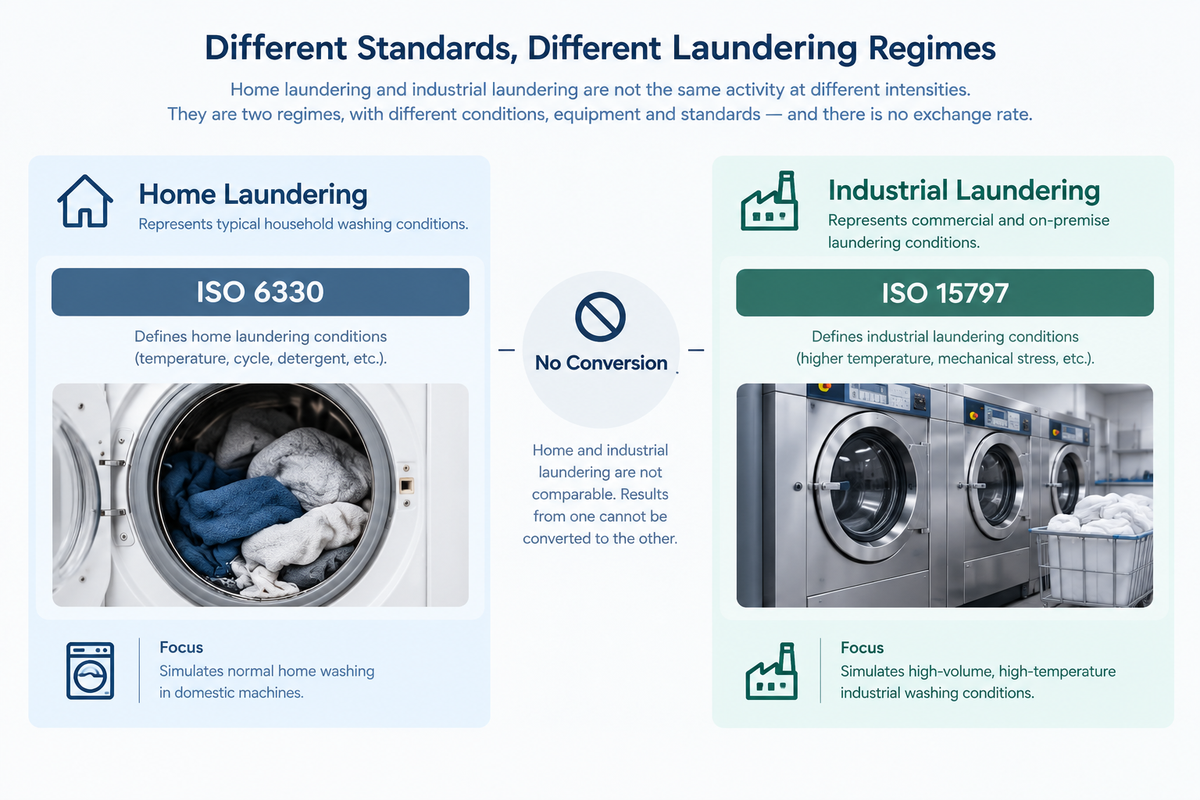
Home laundering and industrial laundering are not the same activity at different intensities. They are two regimes, described by two different standards, with two different units.
The dividing line is stated in the standards themselves. ISO 105-C06, which covers colour fastness to domestic and commercial laundering, is written for normal household articles — and it notes that industrial and hospital articles may be subjected to special laundering procedures that may be more severe in some aspects. ISO 15797 takes that separate case and defines it properly: industrial washing and finishing procedures for testing workwear, with eight washing procedures, where each procedure is considered to represent a single industrial wash, plus two drying and finishing procedures — tumble drying, and tunnel or cabinet finishing. That standard is explicit that it simulates industrial conditions, and that a final determination of product and process compatibility may need testing in the actual industrial equipment and process intended.
There is a second, sharper indication of how far apart the two regimes sit. AATCC TM61 was originally written with a commercial-laundering dimension, and in 2005 AATCC removed all references to commercial laundering from the method, on the basis that it was not known whether the procedure accurately replicates typical commercial laundering processes used today.
So consider a supplier claim written as "industrial washing cycles". If the supporting work was a domestic laundering method, the word is not adding information — it is adding weight. A domestic machine running a domestic programme and a washer-extractor running an industrial programme are not the same event, even before temperature and chemistry are specified, and a count produced under one cannot be converted into the other. There is no exchange rate.
For a buyer, the practical consequence is simple. Decide which regime your programme actually operates in — home care, or industrial processing — and then require the durability claim to be written in that regime's units. A home-laundering count quoted at a workwear programme is not a conservative estimate. It is a measurement of something else.
What Each Standard Measures, and What It Doesn't
The methods most often named in this discussion fall into two groups, and the distinction between them is where most of the confusion starts: some define the washing, and some measure a property after washing. They are not alternatives to one another, and neither group is a pass mark.
| Standard | What it defines or measures | What it does not cover |
|---|---|---|
| ISO 6330 | Domestic washing and drying procedures for textile testing; reference detergents and ballasts; each procedure represents a single domestic wash | Any property. It sets conditions, not results |
| ISO 15797 | Industrial washing and finishing procedures for testing workwear; eight washing procedures, each representing a single industrial wash; two drying and finishing procedures | General apparel; and it does not provide instructions for industrial launderers |
| AATCC TM135 | Dimensional — length and width — changes of fabrics after home laundering; four washing temperatures, three agitation cycles, four drying procedures | Garments; colour; adhesion. It measures size change only |
| AATCC TM150 | Dimensional changes of garments after home laundering; notes that garment construction, tensions, sewing threads and trims can affect the result; may not apply to certain stretch fabrics | Colour; adhesion. It measures size change only |
| AATCC TM61 | Colour fastness to laundering, accelerated; one 45-minute test roughly approximates five hand or home launderings | Adhesion; and since 2005 it carries no reference to commercial laundering |
| ISO 105-C06 | Colour fastness to domestic and commercial laundering; one single test approximates one laundering, one multiple test may approximate up to five at temperatures not exceeding 70 °C | Adhesion; and industrial and hospital articles may fall outside its normal scope |
Read down the right-hand column looking for the property that decides whether a buyer has a problem — whether the print is still joined to the garment — and it is not there. The washing standards define conditions. The property standards measure dimension and colour. Neither group is an adhesion standard.
That is not a defect in the standards. It is a boundary, and knowing where it sits is what changes how you read a claim.
The second thing to take from the table is that these are methods, not certificates. "Tested to ISO 6330" describes how a garment was washed. It does not say the garment passed anything. A pass exists only when someone applies a criterion — and as the previous section showed, the criterion usually comes from the buyer, the brand or the supplier rather than from the standard.
What to Ask Before You Accept a Wash Count
There is a pattern worth noticing here. Nearly every wash-durability question we get is about the cycle count — almost never about the conditions it was measured under. The count is the part that fits on a data sheet. The conditions are the part that decide what it means.
So when a supplier gives you a figure, ask for the four things that would let you compare it. They are short questions, and the answers are quick to give when the work was done properly.
| What the claim gives you | What to ask for | Why it moves the number |
|---|---|---|
| "50 washes" | Which laundering regime, and which procedure — domestic or industrial, which machine, which drying method | Different procedures apply different thermal, mechanical and chemical loads to the same print |
| A cycle count | Whether the figure counts cycles or accelerated tests — and how many washes each test is taken to represent | One accelerated test can stand in for several launderings, so "one" and "one" may not agree |
| A durability statement | The failure criterion, and who set it | First visible change and structural failure produce very different counts from the same sample |
| A single number | How many samples, and from how many production lots | Results from one sample describe one sample; batch consistency is a separate question from average performance |
| "Tested to [standard]" | Whether the result was a pass against a stated criterion, or a description of the conditions used | Methods describe procedures; a pass requires a criterion the method itself does not supply |
The fourth row deserves a word of its own. A durability figure drawn from a handful of samples taken from a single production run tells you about that run. Whether the same figure holds across later batches is a different question — and for anyone buying at volume, it is often the more expensive one.
Building a Comparison You Can Defend
You do not need a laboratory to make a durability claim comparable. You need four things written down before the first wash, and the discipline to keep them fixed.
Samples. Identify what you are testing precisely — the film, the ink, the powder, the fabric, and the press conditions used. Change one variable at a time, and use enough pieces that a single outlier does not become your answer.
Conditions. Record the procedure, not just the temperature. Which machine, which programme, which detergent, which drying method. If you are comparing your own results against a supplier's, this is the row where the comparison usually collapses.
Interval. Decide in advance when you will look — after every cycle, or at fixed points — and keep looking at the same point in the process each time. A result read immediately after drying and a result read the next morning are not the same measurement.
Criterion. Write the failure definition down before you start, and apply it without adjusting it mid-test. If the criterion changes when the results arrive, the test has stopped measuring durability and started measuring expectations.
The output of this is not a bigger number. It is a number you can defend, and a second number you can compare it to. That is the whole return: not "how many washes does our print survive", but "do these two perform the same way under the conditions we actually use".
If you are sourcing transfers rather than printing in-house, the same four elements apply — you are simply asking a supplier for them instead of setting them yourself. The framework does not change with who runs the washes.
If you are working to a wash requirement in a garment programme, tell us the fabric and the laundering regime you are specifying for. We will point you to the film specification that fits, so you can run your own comparison against your own conditions.
Conclusion
Two buyers read the same line on the same specification sheet: 50 washes.
One treats it as a requirement and moves on. The other asks what counted as a failure, under which procedure, on how many samples. Both now hold the same number. Only one of them knows what it measures.
That gap is the subject of this article. A wash count is the last line of a measurement, not the first line of a product description — and the lines above it are the ones that decide whether the number applies to your garment, your laundry and your customer. Ask for the procedure, the conditions and the criterion first. What remains afterwards is a number with a unit, which is the only kind you can build a specification on.
FAQ
How many washes does a DTF transfer last before it fails?
Can DTF transfers survive industrial or commercial laundering?
What counts as one wash cycle in a durability claim?
Is ISO 6330 a certification for DTF film?
How do I compare wash-durability claims from two suppliers?
Can a transfer be re-pressed after it starts to lift?
Contact Us
Tell us your requirements and our team will get back to you within 24 hours.

Ellen Lin
Product Manager & Heat Transfer Materials Specialist
Ellen Lin is a Product Manager at LorinTransfer, specializing in heat transfer materials, DTF printing solutions, and UV DTF transfer products. With hands-on experience in product development and market research, Ellen works closely with manufacturing teams and printing professionals to improve product performance, application methods, and customer solutions. She shares insights on transfer printing technologies, material selection, and industry trends to help businesses make better decisions for their printing projects.
Related Articles
DTF Film, Ink and Powder: Why the Problem You See Is Almost Never Where It Started
The film, ink and powder on a DTF line are three positions on one chain, and the hand-off between them decides what your press can do. When a transfer goes wrong, the symptom usually shows up far from where it started.
DTF Printing on Dark Fabrics: Isolate the Cause Before You Adjust Settings
A faded print on a black shirt usually gets worked on in one of two places: the heat press, or the white ink settings in the RIP.
DTF Transfers for Print on Demand: A POD Seller’s Sourcing Guide
There is a moment in the life of almost every custom apparel store when the numbers quietly stop working. Orders arrive, designs sell — and the fulfillment receipt still shows you keeping five to eight dollars on a twenty-five dollar shirt.