DTF Transfers for Print on Demand: A POD Seller’s Sourcing Guide

There is a moment in the life of almost every custom apparel store when the numbers quietly stop working. Orders arrive, designs sell — and the fulfillment receipt still shows you keeping five to eight dollars on a twenty-five dollar shirt, before ad spend, before returns, before the subscriptions. That is usually the moment sourcing stops being a background detail and becomes the main business question.
This guide is about that decision: whether to keep letting a print-on-demand platform fulfill everything, or to buy DTF transfers and press the shirts yourself — and if you buy, whether to buy from a domestic supplier or direct from an overseas manufacturer. One thing you should know up front: LorinTransfer is a China-based manufacturer of DTF film and custom heat transfers, and we work with POD sellers. Where overseas sourcing makes sense, we will say so. Where it does not, we will say that too — because the right sourcing model depends on your order profile, not on who wrote the article.
The short answer: for stores still testing designs at low volume, a POD platform is usually the simpler choice. Once you have stable bestsellers and enough volume to plan inventory, buying ready-to-press DTF transfers and pressing garments yourself typically improves unit economics. Cross-border sourcing becomes worth considering when your delivery model can absorb longer replenishment cycles. The rest of this guide shows you how to make those calls with your own numbers.
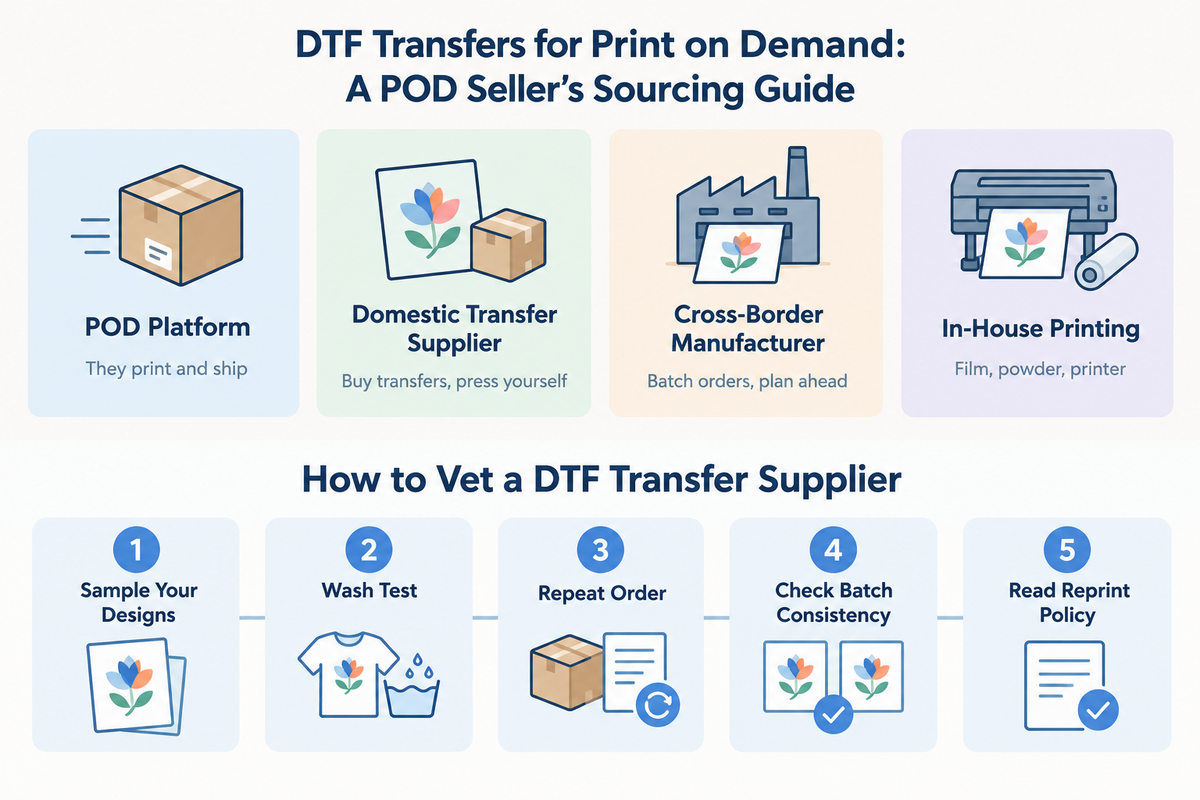
What You’re Actually Choosing Between: Four Ways to Fulfill a POD Order
Much of the confusion in this space starts with a false opposition: "DTF vs print on demand." Buying transfers is not the opposite of print on demand. You still print nothing until someone buys. The real question is who does the printing, and how far upstream you sit in the supply chain.
A POD platform (Printful, Printify, Gelato) prints, packs, and ships for you. You never touch the product, carry no equipment, and pay the highest per-unit cost for that convenience.
A domestic transfer supplier prints your designs onto film and ships them to you, typically within a few days. You press them onto blank garments with a heat press as orders come in.
A cross-border manufacturer — the category we belong to — produces transfers (and, later, printing materials) in batches, usually at lower unit pricing and lower minimums, but with a longer freight window that has to be planned around.
In-house printing puts you at the top of the chain: you buy film, powder, and ink, own a printer, and control every step. It is also the largest operational commitment of the four.
Each step upstream trades cash and labor for unit cost and control. Buy ready-to-press transfers. The mistake sellers make is not choosing the wrong step — it is skipping the analysis of which step their orders actually justify.
Your Order Profile Decides: Four Variables That Pick the Model
"Which is better" is the wrong question. Four variables decide it for you.
Monthly order volume. At 20–30 orders a month, the dollars you lose to platform markup are real but survivable, and your time is usually better spent on design and marketing than on fulfillment. Between roughly 50 and 300 orders a month, the margin difference can become large enough to justify looking seriously at your fulfillment model.
Design churn. If you launch new designs weekly and most of your catalog sells once or twice, on-demand fulfillment (platform or per-order transfers) fits — you cannot batch-print a catalog that changes faster than freight. If you have a stable set of top sellers, batch production becomes the cheapest way to serve them.
Price band. A $35 premium streetwear piece absorbs fulfillment cost comfortably. A $22 novelty tee does not — at that price point, the sourcing model is the difference between a store that scales and one that stalls.
Your delivery promise. If your listings promise 3–5 day delivery and you hold no stock, a long-freight model is not an option for you, no matter the unit economics. If your customers happily wait 1–2 weeks for a design they cannot get elsewhere, it is.
Put together: a seller doing 150 orders a month with ten proven designs and a patient audience is the textbook case for buying transfers in batches. A seller testing 40 new designs a month at low volume should stay on a platform. Most growing stores are some mix of the two — which is exactly what the planning method below is for.
To turn those variables into a starting point — a framework to reason from, not an industry threshold:
| Your situation | Model to look at first |
|---|---|
| Under ~30 orders a month, still testing designs | POD platform |
| 30–100 orders a month, mixed catalog of hits and long tail | Hybrid: platform for new designs, batch transfers for proven ones |
| 100+ orders a month with proven designs | Buy ready-to-press transfers (domestic or cross-border) |
| Stable high volume, plus production capability and appetite | In-house printing |
The thresholds are illustrative. The honest version of this table is a set of questions: does your volume justify equipment and labor? Does your catalog stabilize enough to batch? Can your delivery promise tolerate planning ahead? Where the answers flip is where your model changes.
The Unit Economics, Counted Honestly
Most "POD vs DTF" comparisons you will find online were written by someone selling one of the two. Here is the arithmetic with the costs both sides tend to omit, using a $25 shirt.
| Cost item | POD platform | Self-press with transfers |
|---|---|---|
| Base product + print | ~$11–13 (Bella+Canvas 3001 class blank, platform catalog pricing, checked 2026) | Blank tee ~$3–6 + transfer ~$1.50–4.50 (size- and supplier-dependent) |
| Shipping | US fulfillment shipping ~$4–5, typically charged to the buyer | Inbound freight on blanks and transfers; outbound label to the buyer |
| Marketplace fees (Etsy-type) | Listing + transaction + processing fees | Same |
| Returns / misprints | Platform absorbs production errors | You absorb — a wash-failed batch is your refund |
| Your time | Near zero | Press, pack, ship: minutes per order |
| Estimated product-level margin at $25 | Roughly $5–9 (before labor, ads and overhead) | Roughly $14–18 (before labor, ads and overhead) |
Two notes on reading the table. Where the buyer pays delivery, shipping is excluded from both columns; if you offer "free" shipping, add that cost back to whichever side you are comparing. And the margin figures are product-level: they exclude packaging, wasted presses, blank inventory loss, equipment amortization, and — the two items that usually decide whether either model actually profits — ad spend and your own labor.
Platform pricing moves and plan tiers change it — Printful’s current catalog, for instance, lists the Bella+Canvas 3001 near $12 with US shipping from about $5 (checked September 2026) — so verify current numbers on the platform’s own catalog before building your pricing model.
One more nuance: many POD listings are fulfilled with DTG or other direct-print methods — the exact method depends on the platform, the product, and sometimes the option you pick at setup — and the print characteristics differ from DTF in ways your customers will notice on dark garments and fine detail. We break down how DTF and DTG prints differ on fabric in a separate comparison.
When is the platform the right answer? When you are still testing designs, when you travel, when your volume does not yet justify a $300 heat press and an hour a day of fulfillment. The platform premium is the price of not running a micro-factory. It stops being worth it the day your top designs stop changing and your volume makes the fulfillment cost gap a line item worth attacking directly.
Domestic vs Cross-Border: The Trade-Off Nobody Explains Both Sides Of
Most content on this question is written by domestic suppliers explaining why you should not order from China — fast shipping, no customs, easy reorders. All of that is true. Here is the complete picture.
| Domestic supplier | Cross-border manufacturer | |
|---|---|---|
| Production + freight | Typically days | Typically one to several weeks, depending on freight method |
| Per-unit pricing at low order quantities | Higher | Lower in most cases — but compare landed cost (unit price + freight + duties), not sticker price |
| Customs & duties | None | A real line item; confirm terms (who clears, who pays) before ordering |
| Customization depth (private label, specialty finishes, packaging) | Limited by product menu | Broader, within manufacturer capability |
| Communication | Same time zone, fast turnaround on questions | Time-shifted; batch your questions and plan ahead |
| Best fit | Rush orders, one-off designs, small tests | Batch replenishment of proven sellers, custom programs, scaling volume |
The case for domestic is simple: if you need transfers this week, buy them domestically. The case for cross-border is arithmetic: when you can plan even two weeks ahead, the unit-cost difference on a batch of proven designs is one of the most practical ways to improve unit economics — provided the supplier clears the quality bar, which is what the next section is about.
And the case against us, stated plainly: if you promise 3-day delivery, if you hold no stock, if your designs turn over faster than freight, a cross-border model will hurt your store regardless of the price. No unit price fixes an operational mismatch.
How to Plan Around a Longer Lead Time
The sellers who succeed with cross-border sourcing run a two-track system:
Track one: batch-print your proven sellers. Your top designs have predictable demand. Print them in quantity, store them, and press as orders arrive. This is where the freight window stops mattering: a transfer that arrives in two weeks and sits in a drawer for three more is not late — it is inventory. Printed transfers are among the friendliest inventory a small business can hold: they store flat, take up a drawer rather than a rack, and many suppliers recommend treating 6–12 months as a practical storage window when transfers are kept cool, dry, sealed, and away from direct light — the window varies with film, ink, adhesive, and storage conditions rather than being a fixed industry standard. (Humidity is the main enemy — it degrades the adhesive layer long before the print itself fails.)
Track two: stay on-demand for everything else. New designs, one-offs, and long-tail catalog items get fulfilled per order — via a domestic supplier or your platform — until they earn a spot on the batch list.
Two practices make this system work. First, gang sheet layout: when you order DTF gang sheets, you tile multiple designs onto one sheet, which typically lowers cost per design enough to change what is worth batch-printing. Second, a reorder trigger: when the stored stock of a top seller falls below what you expect to sell during one full replenishment cycle (production + freight), place the next order. That single rule prevents both stockouts and overstock.
On the cash side, this is where the model earns its keep: tying up $150 of transfers for your ten best designs ties up far less cash — and depreciates far more slowly — than the same coverage in blank garments or pre-pressed stock.
Vetting a Transfer Supplier Before You Bet Your Store on Them
There is no single "best" DTF transfer supplier for every POD seller. The best supplier for your store is the one that matches your order volume, replenishment cycle, quality requirements, and delivery promise — which is why this section is about how to evaluate one, not who to pick.
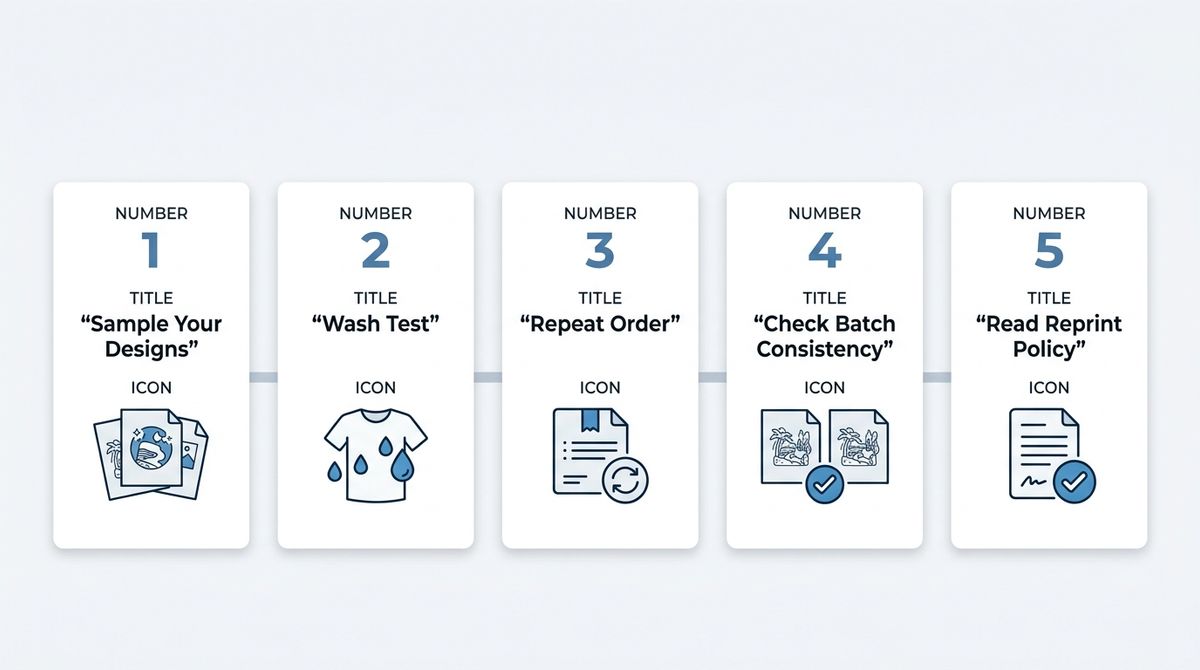
On a marketplace, a bad print costs you a refund. On your own store, a bad batch costs you reviews — and reviews are the asset your traffic runs on. Before you commit volume to any supplier (including us), run this sequence:
Order samples of your actual designs. Not their stock images — your artwork, at your real sizes, on the film you would actually buy. You are testing their production, not their marketing.
Wash-test before you judge. Press per the supplier’s stated settings, then wash the garment inside-out in cold water, 5–10+ cycles. Suppliers commonly claim anywhere from 50 to 100+ wash durability; your own test is the only number that matters. Suppliers’ recommended temperature and time settings vary between products — follow the specifications for the exact film and powder you are using.
Place a second, smaller order. This is the step almost everyone skips. The question is not "can they print well once" — it is whether order two matches order one in color, registration, and hand feel. Batch-to-batch inconsistency is the failure mode that quietly destroys POD stores, because it surfaces as scattered one-star reviews weeks apart, each one individually deniable.
Test their file handling. Send a design with a known quirk (transparent background, small text) and see what comes back and how they communicate. Your reorder speed depends on this pipeline more than on their print speed.
Read the reprint policy before you need it. Custom-printed transfers are generally non-returnable; the difference between suppliers is what happens when the defect is theirs. Get the policy in writing before the first bulk order, not after the first dispute.
If quality problems show up after orders ship, diagnosing them is a separate skill — our guide to DTF transfer problems and their real causes covers the press-side and material-side causes worth ruling out before you blame the supplier.
This is also why we offer free samples of our heat transfer materials: hold any supplier, us included, to exactly this standard, and let the wash test decide.
When to Stop Buying Transfers and Start Printing Your Own
In-house printing stops being a lifestyle and starts being a business decision when three signals line up: your monthly transfer bill keeps climbing with no ceiling in sight; lead times, not costs, have become the constraint on your growth; and your customization needs are pushing past what a transfer supplier’s product menu offers.
At that point the economics genuinely invert — you trade a per-unit cost for a fixed cost you own. But go in with your eyes open: the equipment, maintenance, and learning curve behind the real startup costs of printing DTF in-house are a different commitment than pressing transfers. For sellers who do decide to move upstream, starting with smaller-format equipment reduces the initial commitment — A3 and A4 DTF film sheets are one practical option for small-format setups before anyone commits to roll-to-roll production. Daily printer maintenance is the line item that surprises people most — ink systems that idle badly will consume your margin in cleaning cycles if your volume does not keep them running.
Conclusion
The sourcing decision for a POD seller is not "DTF or print on demand" — it is which of four supply chain positions your order profile justifies today, and which it will justify next quarter. Profile first: volume, design churn, price band, delivery promise. Economics second, counted honestly with the costs both sides like to omit. Then supplier — verified by samples, wash tests, and a repeat order, not by who ranks first in a blog post. And if longer freight windows fit your model, plan in two tracks: batch-print what has proven demand, stay on-demand for the rest.
If your order profile points toward a cross-border manufacturer, send us your typical order volume, transfer sizes, and preferred delivery window — we can recommend a sampling and replenishment approach before you commit to a larger batch. And if it points toward a domestic supplier or a platform, take that answer; it will still be right when your volume changes.
FAQ
Can I use DTF transfers together with a platform like Printful or Printify?
How many washes should a good DTF transfer survive before I order in bulk?
Is buying DTF transfers from China actually cheaper?
Do I need a heat press, or will a household iron work?
How long do pre-printed DTF transfers last in storage?
Contact Us
Tell us your requirements and our team will get back to you within 24 hours.

Ellen Lin
Product Manager & Heat Transfer Materials Specialist
Ellen Lin is a Product Manager at LorinTransfer, specializing in heat transfer materials, DTF printing solutions, and UV DTF transfer products. With hands-on experience in product development and market research, Ellen works closely with manufacturing teams and printing professionals to improve product performance, application methods, and customer solutions. She shares insights on transfer printing technologies, material selection, and industry trends to help businesses make better decisions for their printing projects.
Related Articles

What DTF Film Can Your Printer Run? Matching Specs by Machine Class
Few purchases fail as quietly as the wrong roll of DTF film. It arrives on schedule, wound neatly on its core, exactly the width the product page advertised — and it does not fit the machine it was bought for.

Hot Peel vs Cold Peel DTF Film: Setting Your Production Standard
It depends. That is where most guides to hot peel vs cold peel DTF film land, and it is not wrong — it is just unfinished.

How to Use DTF Film: Step-by-Step Application and Peel Guide
A practical guide to using DTF film: the full application workflow, hot vs cold peel timing, why heat press settings vary, and how to keep results consistent from one press to a production run.