How to Choose the Right Heat Transfer Vinyl (HTV) for Your Business

Ask a decorator "which HTV should I use?" and the honest answer is almost always "it depends." Heat transfer vinyl is not one material — it is a family of materials built around different base films, surface effects, and adhesives, and each combination suits a different job. Choose by fabric alone and you miss half the decision; choose by look alone and you may end up with a film that cracks on a stretch fabric or washes out after a few cycles.
This guide walks through the main HTV types and why they behave the way they do, how to match them to fabric and end use, and the two things most buyer guides skip entirely: material quality and batch-to-batch consistency. It is written for print shops, POD sellers, and small production teams who buy heat transfer vinyl by the roll and need their choice to hold up across repeat orders.
1. Types of HTV — and Why They Behave Differently
Heat transfer vinyl is a thin material with a heat-activated adhesive on the back. It is cut into a design, weeded, then pressed onto fabric. The differences between HTV types come down to three layers: the base film, any surface-effect layer, and the adhesive.
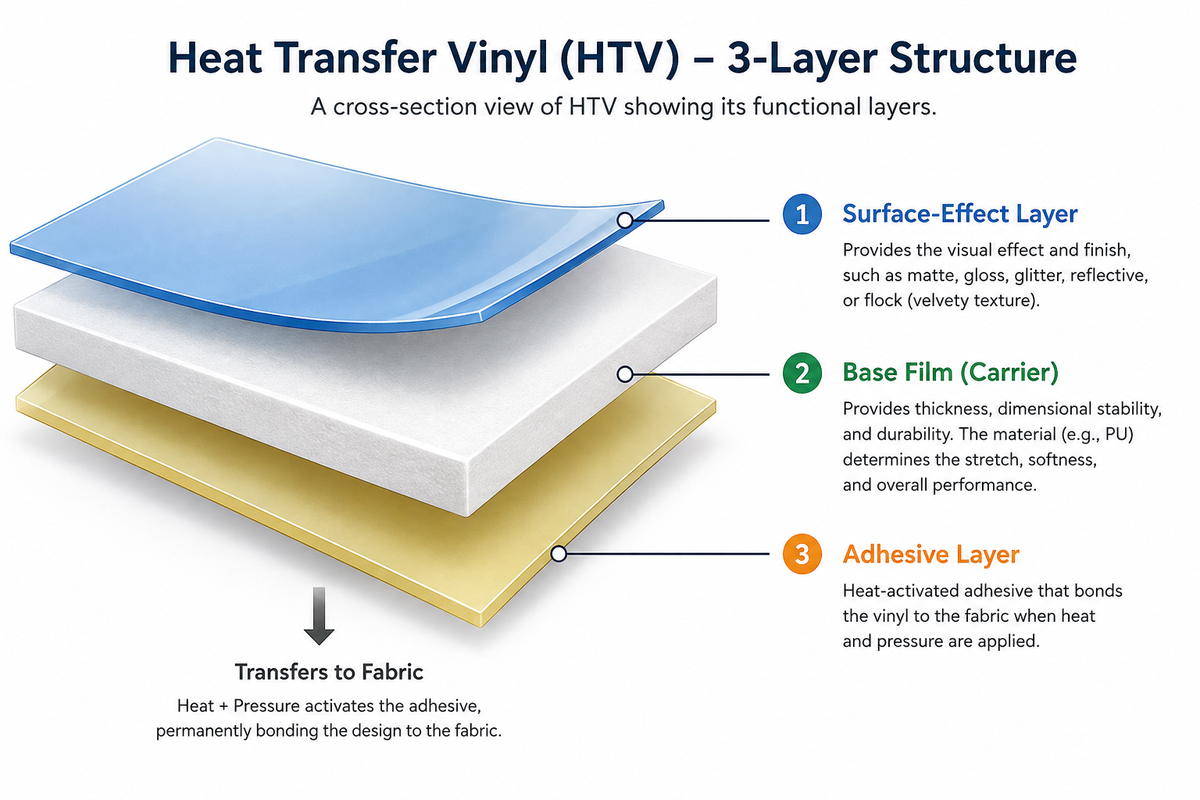
PU HTV (polyurethane) is the most widely used type. It is soft, thin, and elastic, which is why it moves with stretchy fabric instead of cracking. Its base is polyurethane rather than PVC, giving it a softer hand and better stretch recovery — the two properties that matter most on sportswear and fitted garments.
Glitter HTV embeds sparkling particles in the surface. The effect is decorative rather than structural: it adds shine and dimension, which makes it popular for dancewear, event merchandise, and fashion pieces where the look is the point. The trade-off is a slightly thicker, less flexible surface than a plain PU film.
Reflective HTV uses glass microspheres in the surface to bounce light back toward the source. It is the material behind high-visibility safety wear, running gear, and workwear, where visibility in low light is a functional requirement rather than a style choice.
Flock HTV has a raised, velvety surface made from short fibers. It reads like a premium, tactile finish — think varsity lettering and team crests — and it is chosen for that texture rather than for stretch or shine.
The practical point: the type you pick is really a choice about which property you are optimizing for — stretch (PU), sparkle (glitter), visibility (reflective), or texture (flock). Understanding that makes the next two decisions easier.
| Type | What it optimizes for | Best for |
|---|---|---|
| PU HTV | Stretch + soft hand | Sportswear, fitted garments, everyday branding |
| Glitter HTV | Sparkle + dimension | Dancewear, event merchandise, fashion |
| Reflective HTV | Visibility in low light | Safety wear, running gear, workwear |
| Flock HTV | Raised, velvety texture | Varsity lettering, team crests, premium finishes |
2. How to Choose HTV by Fabric
Fabric is the first filter, because the adhesive and base film have to bond with what you are pressing onto.
Cotton is the most forgiving. Most HTV types adhere well, so your choice is usually driven by look and use rather than compatibility.
Polyester and blends need a little more care. Some HTV formulations are made to press at a lower temperature, which matters because polyester can scorch or discolor under high heat. Confirm the recommended pressing conditions for the specific vinyl and fabric rather than assuming every HTV presses the same way.
Stretch fabrics are where the base material really shows. A rigid vinyl cracks when the garment stretches and recovers. PU HTV, with its elasticity, is the safer default — and this is where material quality matters most, because a cheap "PU" with poor elasticity still cracks.
Dark fabrics raise a coverage question. For a design to read cleanly on black or navy, the vinyl must be opaque enough to hide the fabric behind it. Thin or low-opacity films let the garment color bleed through, so check opacity on a dark swatch before committing.
Nylon and coated or waterproof fabrics are the trickiest. Their smooth, low-energy surface resists adhesion, so these often need a vinyl specifically formulated for that substrate. If your order mix includes them, test first.
3. How to Choose HTV by End Use — a Decision Framework
If fabric is the first filter, end use is the second. Matching the material to what the garment actually has to do removes most of the guesswork.
| End use | Recommended HTV | Why |
|---|---|---|
| Sportswear / activewear | PU HTV | Stretch + soft hand |
| Safety / hi-vis workwear | Reflective HTV | Visibility is a functional requirement |
| Team uniforms, names & numbers | PU + reflective/flock accents | Durability base, effect where the design calls for it |
| Fashion / promotional pieces | Glitter or flock HTV | The look and texture are the selling point |
| Everyday branding / simple logos | PU HTV | Cost + durability + fabric range |
Two notes on how to read this. First, these are starting points, not rules — a specific order may override them. Second, the framework only works if the material itself is good; a decision table cannot fix a film that cracks or a color that shifts. That is the next section.
4. Why Material Quality Changes the Result
Two rolls of "PU HTV" can behave very differently, because the label tells you the type, not the quality.
The adhesive layer is the first thing to fail. A consistent adhesive bonds evenly across the whole design and stays bonded through washing. An inconsistent adhesive is why you see edge lifting, partial peeling, or a design that starts to lift after a few wash cycles.
Elasticity is the second. A PU film that stretches and recovers with the fabric survives activewear. One with poor recovery cracks along the print, no matter how carefully it was pressed.
Color and opacity stability matter for repeat work. If the same color code looks different between two rolls, your finished garments will not match — a real problem when a customer reorders and expects consistency.
The takeaway: when you compare heat transfer vinyl you are comparing specific films and adhesives, not abstract types. A well-made PU film outperforms a cheap one every time, and the difference shows up as returns, complaints, and rework — costs that far exceed the price difference between the two.
5. Batch-to-Batch Consistency — What to Check Before Buying in Bulk
For a business that runs repeat orders, batch consistency matters as much as any single spec.
HTV can vary between production batches in ways that are invisible until you press them: the adhesive bonds slightly differently, the color drifts, or the elasticity changes. Each of those forces you to re-test settings and risks finished goods that do not match the previous run.
This is the question most buyer guides skip, and it is the one that costs a scaling business the most. Before committing to bulk, ask the supplier how they control consistency — whether they batch-test adhesive performance, color, and elasticity, and whether they can provide the same material for reorders. A supplier that can answer those questions is worth more than one that only quotes a lower price.
6. How to Test HTV Before Committing
Never scale a material you have not tested. A short validation step is the cheapest insurance you can buy.
Press a test design on the actual fabric you will use.
Check adhesion: peel the carrier cleanly, with no lifting at the edges.
Stretch it if the garment stretches, and watch for cracking.
Wash it a few times and confirm the color and adhesion hold up.
Actual temperature, pressure, and time vary by vinyl and fabric, so start from the manufacturer's specifications for the specific film you are testing, then adjust in small increments. The same sample-first logic applies on the other side of your shop when you are choosing a DTF film for a print-and-press workflow.
If your shop runs both methods, DTF and HTV are part of the same heat-transfer workflow — matching your materials to one consistent source is worth considering.
Conclusion
There is no single best heat transfer vinyl — only the right one for your fabric, your end use, and the standard of the material itself. Start with the type that matches what the garment has to do, filter by fabric compatibility, then hold the material to a standard: consistent adhesive, real elasticity where you need it, and stable color across batches.
If you are comparing HTV for your own production, test a sample against your most common fabric and order type before you scale. LorinTransfer supplies heat transfer vinyl across the main types, and DTF and HTV are both part of the same heat-transfer workflow — so if your shop runs both, matching your materials to one consistent source is worth considering. Request a sample or contact LorinTransfer to discuss your requirements.
FAQ
What is the difference between PU and PVC HTV?
Which HTV is best for stretchy fabrics and sportswear?
Which HTV lasts longest after washing?
Can I layer different HTV types?
What is the best HTV for a small business starting out?
Contact Us
Tell us your requirements and our team will get back to you within 24 hours.

Ellen Lin
Product Manager & Heat Transfer Materials Specialist
Ellen Lin is a Product Manager at LorinTransfer, specializing in heat transfer materials, DTF printing solutions, and UV DTF transfer products. With hands-on experience in product development and market research, Ellen works closely with manufacturing teams and printing professionals to improve product performance, application methods, and customer solutions. She shares insights on transfer printing technologies, material selection, and industry trends to help businesses make better decisions for their printing projects.
Related Articles
DTF Printing on Dark Fabrics: Isolate the Cause Before You Adjust Settings
A faded print on a black shirt usually gets worked on in one of two places: the heat press, or the white ink settings in the RIP.
DTF Transfers for Print on Demand: A POD Seller’s Sourcing Guide
There is a moment in the life of almost every custom apparel store when the numbers quietly stop working. Orders arrive, designs sell — and the fulfillment receipt still shows you keeping five to eight dollars on a twenty-five dollar shirt.

What DTF Film Can Your Printer Run? Matching Specs by Machine Class
Few purchases fail as quietly as the wrong roll of DTF film. It arrives on schedule, wound neatly on its core, exactly the width the product page advertised — and it does not fit the machine it was bought for.