How to Source DTF Film Wholesale: A 2026 Buyer's Playbook

You're printing more DTF than ever, your film bill keeps growing, and the quotes you get from resellers all start to look the same — marked up 30% or more over what the film actually costs to make. The question most print shops hit at this stage is whether to keep buying through distributors or go direct to a manufacturer.
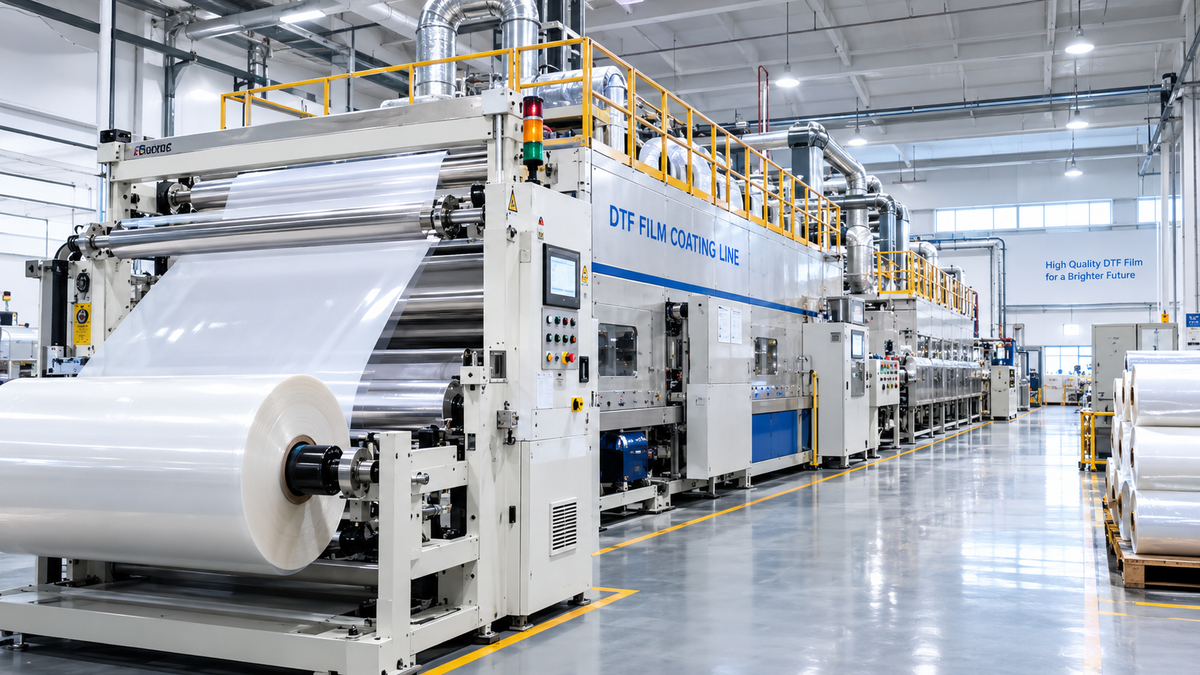
DTF film is a PET transfer film coated with a release layer — the medium that carries your printed design from the printer to the garment. This playbook is written from the factory side of the buying table. We coat DTF film in Xiamen, China and ship it to print shops and garment decorators in the US, EU, and beyond. Here's what wholesale sourcing actually looks like: how MOQs really work, how to separate real factories from traders, what a proper sample run tests, and what shipping and duties to plan for.
Key Takeaways
The DTF film market was worth about $1.45B in 2025 and is projected to reach roughly $3.17B by 2032 (QYResearch) — supply is consolidating around manufacturers with their own coating lines
"MOQ" depends on width and packing: narrow rolls order smaller quantities than 60 cm commercial rolls, so ask for the minimum in rolls and in kilograms
The single most useful filter when vetting a supplier: ask what they coat themselves versus what they resell — a real factory answers in specifics
Budget for a paid trial order before committing to volume; the cost of testing is small next to the cost of a bad first batch
Landed cost is the total to get film to your door — unit price plus freight, duties, and your rework time. Compare quotes on landed cost, not unit price
1. Why More Print Shops Are Going Factory-Direct in 2026
DTF keeps taking ground from older decoration methods, and that changes how film gets bought. IDC reported through 2026 that DTF printers were one of the few growth pockets in graphics printing. DTG shipment value fell over the same period as shops migrated to film-based production. The market data agrees: QYResearch puts the global DTF transfer film market at roughly $1.45 billion in 2025, growing to a projected $3.17 billion by 2032 (11.8% CAGR). The same report notes that US tariff shifts have injected real uncertainty into supply chains, pushing many importers to rethink where and how they buy. Meanwhile, the custom apparel printing market these shops serve keeps expanding: Value Market Research projects custom T-shirt printing growing from $6.28B in 2025 to $17.38B by 2034.
Here's the arithmetic that drives the decision. A distributor buys film from a manufacturer, warehouses it, and adds a margin — commonly 20–40% depending on region and volume. That margin buys you real services: local stock, small order quantities, fast delivery, support in your time zone. But once your monthly film usage climbs past roughly a few hundred kilograms, those services stop being worth the markup. Going direct starts to make sense on cost alone.
For example, a shop running two presses on 60 cm film might order 8-roll cartons monthly from a distributor. The same shop, once its consumption passes roughly 200 kg per month, can usually plan quarterly pallet shipments direct — and compare quotes on a written price ladder instead of a list price.
Where the direct route pays off: shops that consume film on a predictable schedule and can plan orders 2–4 weeks ahead. Where it doesn't (yet): very small shops ordering in single-digit rolls — a local distributor's convenience is usually worth the premium at that scale. Distributors aren't the enemy; the mistake is paying distributor prices at manufacturer volumes.
2. What "Wholesale MOQ" Actually Means for DTF Film
Most first-time buyers ask for "your MOQ" and get an answer that turns out to mean something else later. For DTF film, minimum order quantity usually has three dimensions at once:
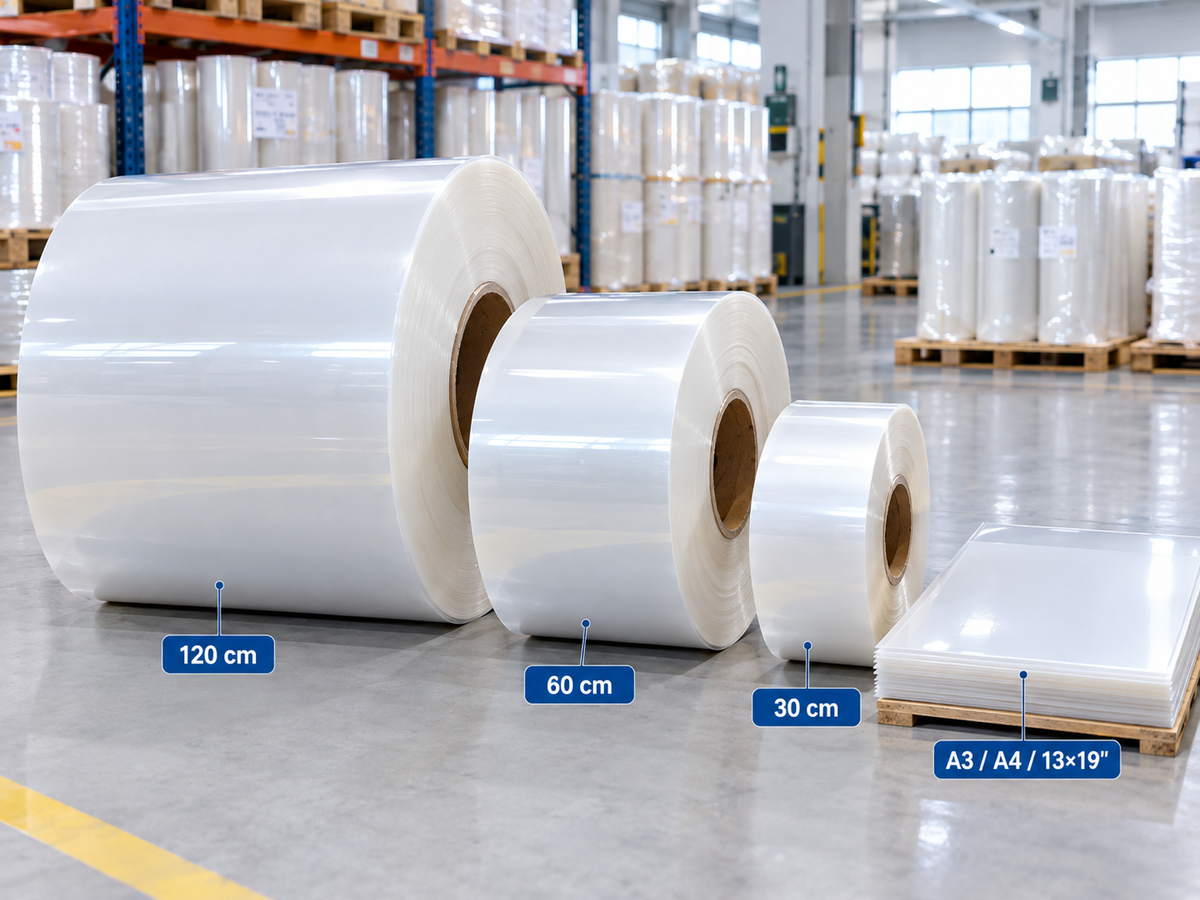
Per width. Film is coated and slit in standard widths — 30 cm, 60 cm, and 120 cm are the common commercial sizes, alongside cut sheets (A3, A4, 13×19"). Narrower widths and sheets typically have lower MOQs because they're lighter and easier to consolidate.
Per roll, then per carton. A 100 m roll of 60 cm film is a very different unit than a 500 m jumbo roll. Ask for both numbers: minimum rolls per size, and how many rolls fit in a carton.
Per shipment. Manufacturers often set a shipping minimum — the order size at which overseas freight becomes economical. This is usually expressed in kilograms or cartons, and it's often the real constraint on a first order.
The practical move: ask for a price ladder from sample quantity to carton, pallet, and container — in writing. A manufacturer with its own coating line will give you a clean ladder; a trader will hedge. Clarify one more thing early: whether MOQ is counted per variant or across the order. For plain film, variants are just width and finish — matte or glossy — so mixed cartons are usually fine. If you're choosing film for a specific printer, how to choose the right DTF film for your printer covers the spec selection side, and you can check our DTF film range for the widths and formats we currently coat.
| Order tier | Typical content | Best suited to |
|---|---|---|
| Sample / trial | 1–2 rolls or a starter pack | First-time evaluation |
| Carton tier | 4–10 rolls per width | Small–mid shops testing a supplier |
| Pallet tier | 20–40+ rolls, mixed widths | Established shops with monthly consumption |
| Container / program | Full palette + scheduled releases | Multi-shop brands, distributors |
Exact figures vary by manufacturer, width, and finish — use this as the shape of the conversation, and get your supplier's real numbers. A good reference point for roll formats is the standard 100 m roll of 60 cm film that most converters produce.
3. 7 Questions That Separate Factories from Traders
The DTF supply chain has two layers: manufacturers who coat the PET film and apply the release chemistry, and trading companies that buy from manufacturers and resell. A release layer is the coating that lets the printed image detach cleanly from the film during pressing. Both layers can be legitimate suppliers, but they have different cost structures — and some traders present themselves as factories. These seven questions sort that out quickly:
"Do you coat the film yourself, or source finished film?" The blunt version. A factory describes coating lines, thickness control, and release-layer chemistry; a trader describes their suppliers.
"What's your thickness tolerance, and how do you control it?" Film is specified in microns (commonly 75–100 μm for DTF applications). Real manufacturers measure it and can explain their QC method — inline gauging, batch sampling, or both.
"Which inks and powders is this film tested with?" Film, ink, and powder behave as a chain. This is why film-ink-powder compatibility decides print quality. A factory that tests with the ink brands you use, or tells you honestly which ones they've validated, is worth more than one with a longer spec sheet.
"Can I see the line?" Ask for a live video call walking the production floor, not a pre-recorded clip. This is a five-minute request that traders cannot satisfy.
"Who else buys this film, and can I talk to one reference?" Reference customers in your region are the strongest signal. Factories with export business usually have standing references.
"What's your defect policy in writing?" Look for a concrete remedy — replacement, credit, or refund — tied to a defined inspection window after delivery.
"What's the batch traceability story?" When you find a good batch, you'll want to reorder that batch. Ask how batches are numbered and how long production records are kept.
None of these require trust up front — they require specifics. Vague answers to any two of them are a signal.
4. From Sample to Production: How a Trial Order Actually Works
Skip the "send us a free sample envelope" stage — two A4 sheets prove nothing about production consistency. A proper trial order tests the film on your press, with your ink and powder, on your jobs. Sort out printer compatibility details before the trial, then run it like this:
Specify the trial. Tell the supplier your printer model, ink system, powder, and the fabrics you print most. Ask them to recommend the width, thickness, and finish for those conditions.
Order a paid trial quantity — typically a carton tier or its equivalent in 2–3 candidate film types. Paid matters: free samples get curated, paid orders come off the line like real product.
Log the test like a job, not a demo. Press the same design across the fabrics you actually sell, through your normal workflow — same powder, same press settings, same wash routine.
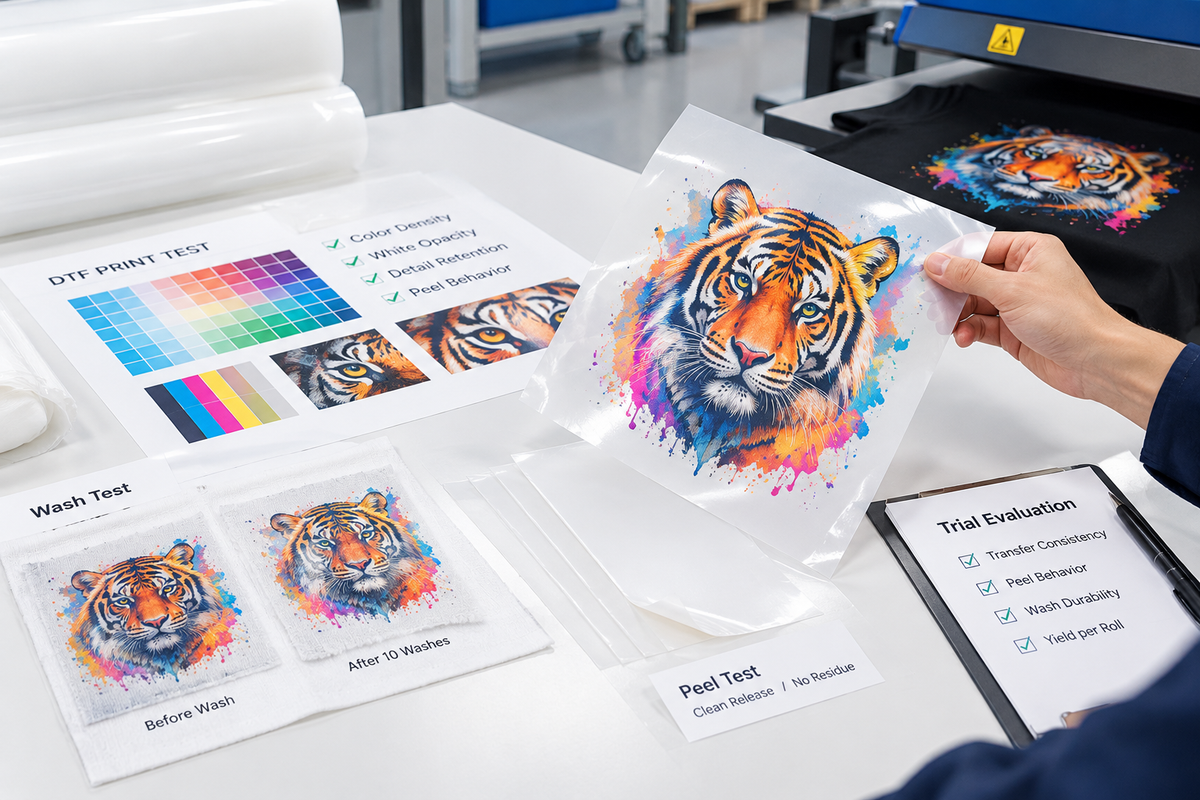
Score the results on four axes:
Transfer consistency — color density, white opacity, detail retention (thin lines, small text)
Peel behavior — hot/cold peel timing window, curling, film release cleanliness
Wash durability — run a real wash test (30°C, inside-out, standard detergent) through at least 10–20 cycles before you trust a batch
Yield per roll — measure actual usable output against your layout; film that costs 5% less but nests 10% worse is a worse film
Then negotiate volume. You're now comparing measured results, not spec sheets — the strongest position a buyer can have.
Expect the trial-to-decision cycle to take two to four weeks including shipping. That's not lost time; it's the cheapest insurance in the whole purchase.
5. What Actually Drives DTF Film Pricing
Unit price per roll hides most of what you're buying. These are the variables that move a factory-direct quote:
| Cost factor | What it means for you |
|---|---|
| Film type & thickness | Standard DTF film, PET-based; thickness (commonly 75–100 μm) and coating quality set the base cost |
| Width & length | 30 cm vs 60 cm vs 120 cm changes material cost per roll; 100 m vs 500 m rolls change handling cost |
| Finish (matte / glossy) | Pricing is usually close between finishes; availability differs by production campaign |
| Order volume & schedule | One-time container vs a release schedule; factories price committed programs better than spot buys |
| Certification & testing | Film specs for skin-contact or children's garments may require additional testing documentation |
| Packaging & private label | Custom cartons and your own branding add cost but build a resalable asset if you distribute |
Matte versus glossy rarely changes the quote much — which finish fits your workflow depends more on your press, your customers, and the peel behavior you've standardized on.
Two practical notes. First, ask for pricing in writing, with the price basis stated — FOB port versus DDP your door. Comparing an FOB price against a DDP quote is comparing apples to shipping crates. Second, if a quote looks dramatically below everyone else's, assume something specific is missing: release-layer quality, thickness tolerance, or the difference between a 100 m roll and a short-count roll. The "too cheap" quote almost always shows up again as rework labor in your shop — we've seen buyers come back after a season of reprints convinced them that cheap batch was expensive.
6. Shipping, Duties, and Lead Times for US and EU Buyers
Film is light but bulks quickly, so freight choices matter more than for most products:
Express courier (DHL/FedEx): trial orders and urgent top-ups. Fast (typically under a week to US/EU) but the most expensive per kilogram.
Air freight: mid-volume, when waiting isn't an option. Roughly 1–2 weeks door-to-door, including consolidation.
Sea freight: the default for volume. Typically 4–7 weeks door-to-door to US/EU depending on port pairs, sailing schedules, and customs processing.
Plan your lead-time buffer around sea freight plus a missed sailing — not the best-case number. Decide the Incoterms question before you order, too. FOB means you control freight from the Chinese port (usually cheapest if you have a forwarder). DDP means the supplier handles everything to your door — simpler, but you're paying their freight margin, and you should confirm duty coverage in writing.
On duties: the US and EU both apply import duties to film products, and rates depend on material classification and current trade policy — which has been actively shifting. Don't trust a rate you saw in a 2024 blog post. Ask your supplier or customs broker for the current landed-cost estimate with the applicable tariff code, and build a few percent of uncertainty into first-order budgeting. A supplier who can't tell you the HS code they ship under is telling you something.
7. Red Flags: When the "Manufacturer" Is a Trader
Traders can be perfectly good suppliers — the problem is only when one claims to be a factory to justify a factory-direct conversation. Watch for these signals:
Prices that move with no production reason. Factory quotes track materials and schedule; trader quotes track whatever their source is doing this week.
Inability to discuss the coating process. Ask what the release layer is for, and listen. A real supplier explains in depth; a trader deflects to "high quality, best price."
Perfect spec sheets, no batch data. Consistency claims without batch records are marketing.
Pressure on the sample stage. "No need to test, everyone buys this" is the opposite of what a confident factory says.
One width, one length, always in stock. Real manufacturers run production campaigns. A trader sitting on one SKU is a middleman with inventory.
None of this means walk away — it means price the relationship as what it is.
Conclusion
Factory-direct sourcing rewards preparation, not luck. Ask the seven vetting questions, run a paid trial through your own production workflow, compare quotes on landed cost with the price basis stated in writing, and plan lead times around real freight schedules rather than hope. Do that once, and you'll know exactly what your film should cost — and who deserves your reorder.
FAQ
What's a realistic MOQ for DTF film from a manufacturer?
How long does shipping take from a Chinese DTF film manufacturer to the US or EU?
Should I test film before ordering in volume?
What thickness DTF film should a print shop order?
Can I get custom widths or private-label packaging?
Is it cheaper to buy DTF film from a distributor or direct from a manufacturer?
Contact Us
Tell us your requirements and our team will get back to you within 24 hours.

Ellen Lin
Product Manager & Heat Transfer Materials Specialist
Ellen Lin is a Product Manager at LorinTransfer, specializing in heat transfer materials, DTF printing solutions, and UV DTF transfer products. With hands-on experience in product development and market research, Ellen works closely with manufacturing teams and printing professionals to improve product performance, application methods, and customer solutions. She shares insights on transfer printing technologies, material selection, and industry trends to help businesses make better decisions for their printing projects.
Related Articles
Can You Use DTF Film in a Sublimation Printer? Honest Answer
You already own a sublimation printer. A customer wants a vivid print on a black cotton tee, and you want to know whether direct-to-film (DTF) film can get you there without a second machine.
DTF PET Film Explained: Structure, Types & Buying Guide
Almost every DTF film listing you open says the same thing in the spec line: PET.
Glitter & Specialty DTF Films: Types, Uses & Buying Guide
Glitter DTF film pulls about 170 US searches a month. Glow-in-the-dark follows at 90, and reflective at 50 (Lorin Transfer keyword research, Google Ads data, Oct 2026).