UV DTF vs Standard DTF: Why the Split Happens at the Ink, Not the Machine

Somebody searches "UV DTF," reads that it needs no heat press, and starts planning a second production line around it. That is the first place the confusion lands. UV DTF is not an upgraded DTF. It is a different decoration process that happens to have inherited half of a name.
The naming is not the industry being careless. UV DTF arrived a few years after standard DTF had already established the acronym as shorthand for "a printed transfer you press onto a garment," so when a UV-cured transfer film showed up, it borrowed the same letters and added its modifier. What it did not borrow was the chemistry, the consumables, the equipment, or the customer. Those all went a different direction, and that is where the practical decisions live.
If you already run a DTF line, the question in front of you is not "UV DTF or standard DTF?" as if they were two answers to one question. It is whether the hard-surface work now arriving in your inbox has accumulated enough to justify a second, fully separate system — and if so, which level of that system you should actually build. The sections below work through the split from its root, then turn it into a decision you can act on.
Two processes, one acronym, and no shared market
Start with the single fact that most comparison content states and then moves past: the two processes are built on different inks. Everything else that people list as a difference — the curing method, what you buy and store, what surfaces each one can touch, how you apply it, how it feels, what "durable" even means for it — is downstream of that one chemical choice.
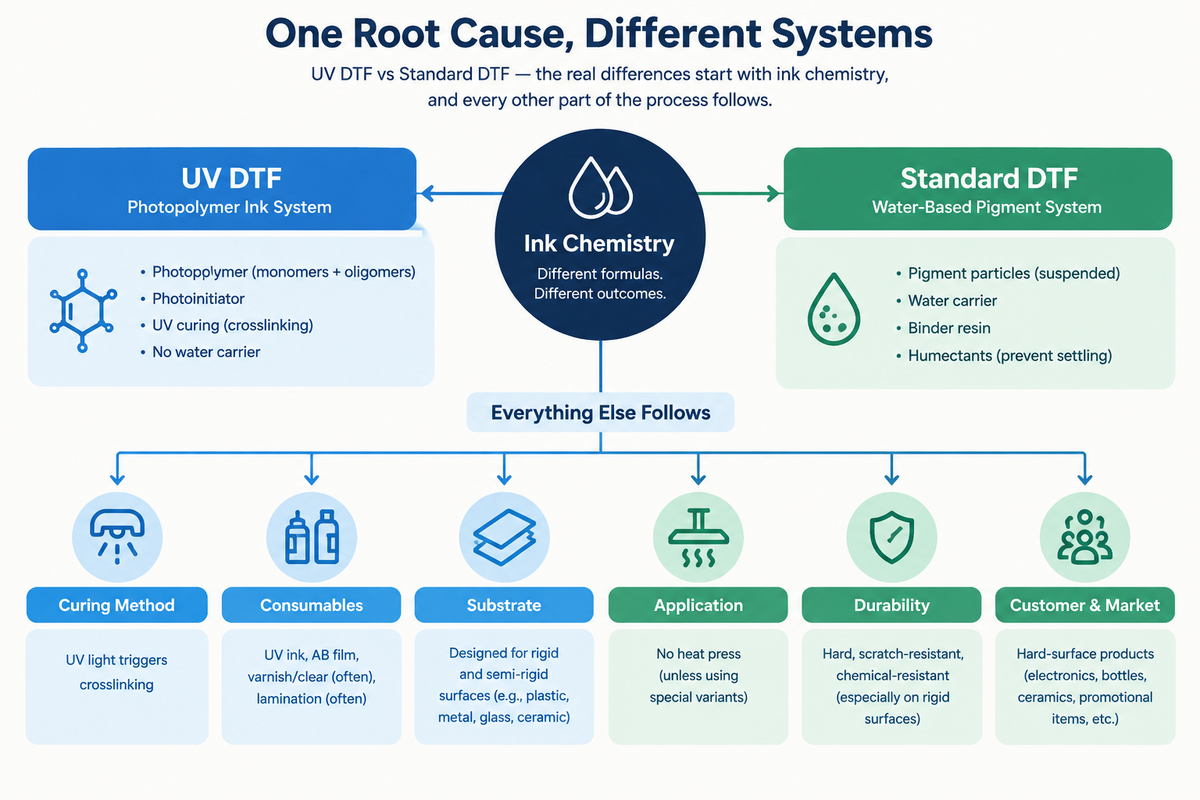
Standard DTF ink is a water-based pigment dispersion. The colour comes from pigment particles, which are suspended rather than dissolved; the liquid carrying them is water; and the formulation also includes a binder resin and humectants that keep the pigment from settling and keep the printhead from drying out between jobs. When the transfer is printed, the water evaporates and the pigment and binder settle onto the PET carrier film as a dry film. The image only becomes a transferable decoration when heat and pressure later reactivate that binder so it can bond to the fabric and to the adhesive powder.
UV DTF ink is a photopolymer. Instead of pigment suspended in water, it is built around short-chain acrylic monomers and oligomers plus a photoinitiator. Nothing about it dries in the ordinary sense — it stays liquid until ultraviolet light hits it and the photoinitiator triggers a near-instant crosslinking reaction that locks the film solid. Cure is a light event, not a heat-and-evaporation event, and that single substitution is what makes a cold, dry, press-free application possible at all.
Because the two inks share neither a carrier nor a curing trigger, they cannot be poured into the same production system and expected to cooperate. The evidence for that is not a matter of opinion, and it is visible in the hardware: the printhead, the ink lines, and the curing assembly of a machine are engineered around one chemistry or the other, and the two are not interchangeable. Anyone planning to run both processes needs to accept that they are building two systems, not configuring two modes on one.
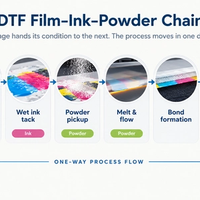
The same logic explains why the ink sits upstream of everything else. In a print-and-transfer process, the ink determines whether the powder can grip, whether the film releases cleanly, and whether the finished layer survives handling — the order of the film-ink-powder chain is fixed, and it runs one way.
The clearest way to see that is to stop thinking of the two as opposite ends of a single scale. They are not the same machine set differently; they serve different substrate classes with different ink paths that never touch.
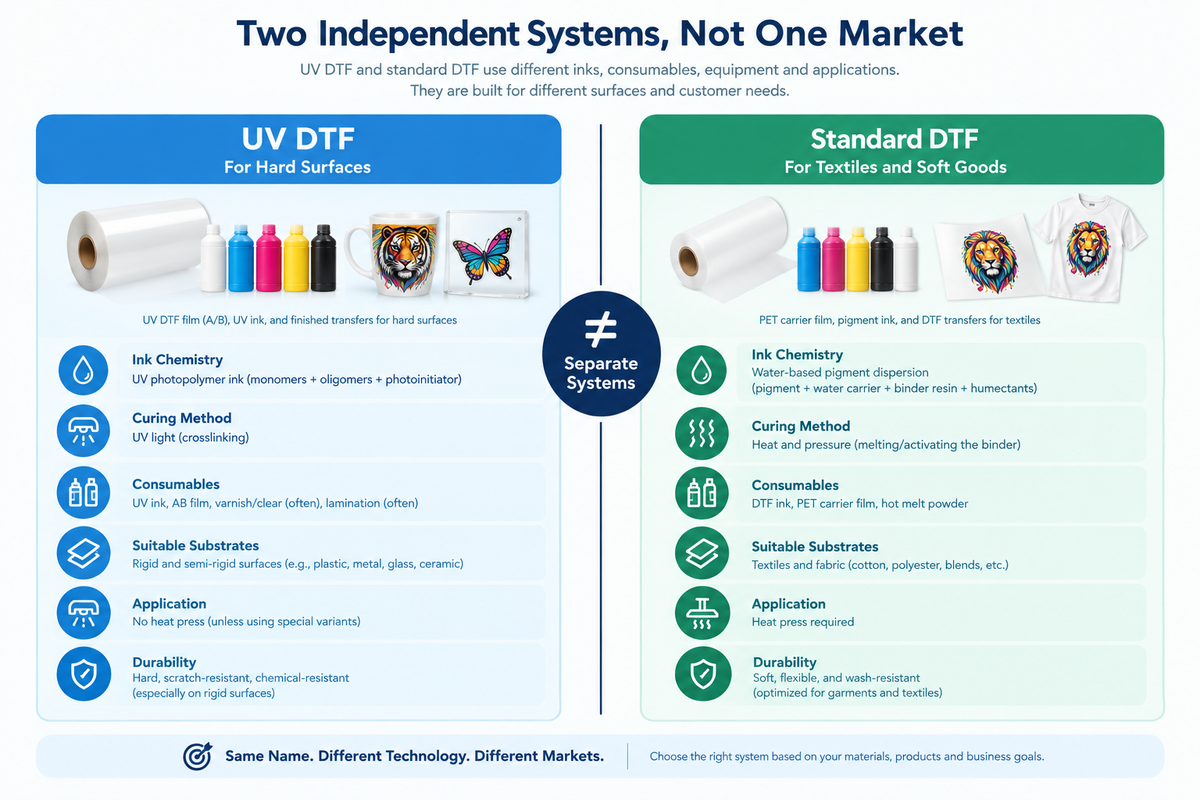
| Standard DTF | UV DTF | |
|---|---|---|
| Ink chemistry | Water-based pigment dispersion (pigment + water carrier + binder + humectants) | Photopolymer (acrylic monomers/oligomers + photoinitiator) |
| Cure mechanism | Water evaporates; binder reactivated later by heat and pressure | UV light triggers crosslinking; no evaporation step |
| Consumables | Water-based ink, PET carrier film, hot-melt powder | UV ink, A/B transfer film (a carrier layer plus a separate top film) |
| Substrate class | Textiles and other soft, fibrous materials | Rigid and semi-rigid hard surfaces |
| Application method | Heat press or tunnel oven (heat + pressure) | Cold hand application — peel, place, press, remove top film |
| Hand feel | Soft; the ink layer follows the fabric | Solid raised layer with a glossier surface |
| Durability dimension | Wash and abrasion cycles on fabric | Surface adhesion, scratch and moisture resistance on a hard surface |
Both processes print an image, cure it into a film, and then transfer that film onto a surface. Both end with a finished graphic that was not printed directly onto the final object. That is genuinely where the resemblance starts and stops — and the word "film" in each column does not mean the same thing. In standard DTF, "film" means the PET carrier film the ink is printed onto, which is discarded once the transfer is pressed. In UV DTF, "film" means an A/B transfer film pair — the image sits between a carrier layer and a top layer, and the top layer is peeled away after application rather than being a heat-transfer carrier.
One table is enough for the choices that sit on the textile side, because those decisions do not change when you also start running hard surfaces. If you are choosing the material for the fabric line itself, that is a separate question with its own method — start from how to choose a DTF film and work from your own fabric, ink, and powder combination. What follows here is about the second system, not the first.
Where each one goes when it leaves its intended surface
The two systems are not merely suited to different surfaces; they fail differently when pushed onto the wrong one, and the failure modes are worth understanding before you promise a customer anything.
Apply UV DTF to a fabric and the problem is mechanical, not adhesive. A UV-cured film is a rigid, crosslinked layer. A garment flexes, stretches, and folds constantly, and a rigid layer sitting on top of it cannot follow that movement — it cracks along the fold lines and flakes at the edges. The transfer may grip the fabric perfectly well at first; the failure comes from the mismatch between a stiff film and a moving substrate.
Apply standard DTF to glass, metal, or ceramic and the problem runs the other way. Hot-melt adhesive is formulated to do two things: melt under heat and pressure, and then grip fibre. On a smooth, non-porous hard surface there is no fibre to grip, and the heat-and-pressure activation that the standard DTF workflow depends on is not part of a cold-application setting. The transfer does not have the conditions it was designed to work under — which is why "it will not stick" is a fair observation but an incomplete explanation.
Neither failure is a defect in either product. Each is the predictable result of using a system whose entire design assumption — fibrous, flexible substrate on one side; rigid, smooth substrate on the other — does not hold.
This is the part that is usually left implicit. The reason a shop cannot simply switch a machine between the two jobs is that the machine is not the variable. The ink is, and the machine is built around the ink. Printheads, ink delivery paths, capping stations, wiper blades, and the pumps that move ink through the system are all specified for a single chemistry. Put a photopolymer through a path designed for a water-based dispersion, or the reverse, and you are asking components to handle a fluid they were never selected for. Equipment makers state plainly that the two ink families are not interchangeable in one machine, and it is worth noting that this comes from companies selling both, so the statement is not a pitch for either side — it is a warning about both.
The decision that actually matters: which level, not which one
If the two systems serve different substrate classes, then "which one should I buy?" is the wrong question for most shops. A shop with a working DTF line does not face a choice between two options for the same job. It faces a question about whether to add a new capability, and if so, how far to build it out.
There are three levels, and they are not just budget tiers — each one describes a different commitment, a different set of things you have to be good at, and a different point at which it stops making sense to go further.
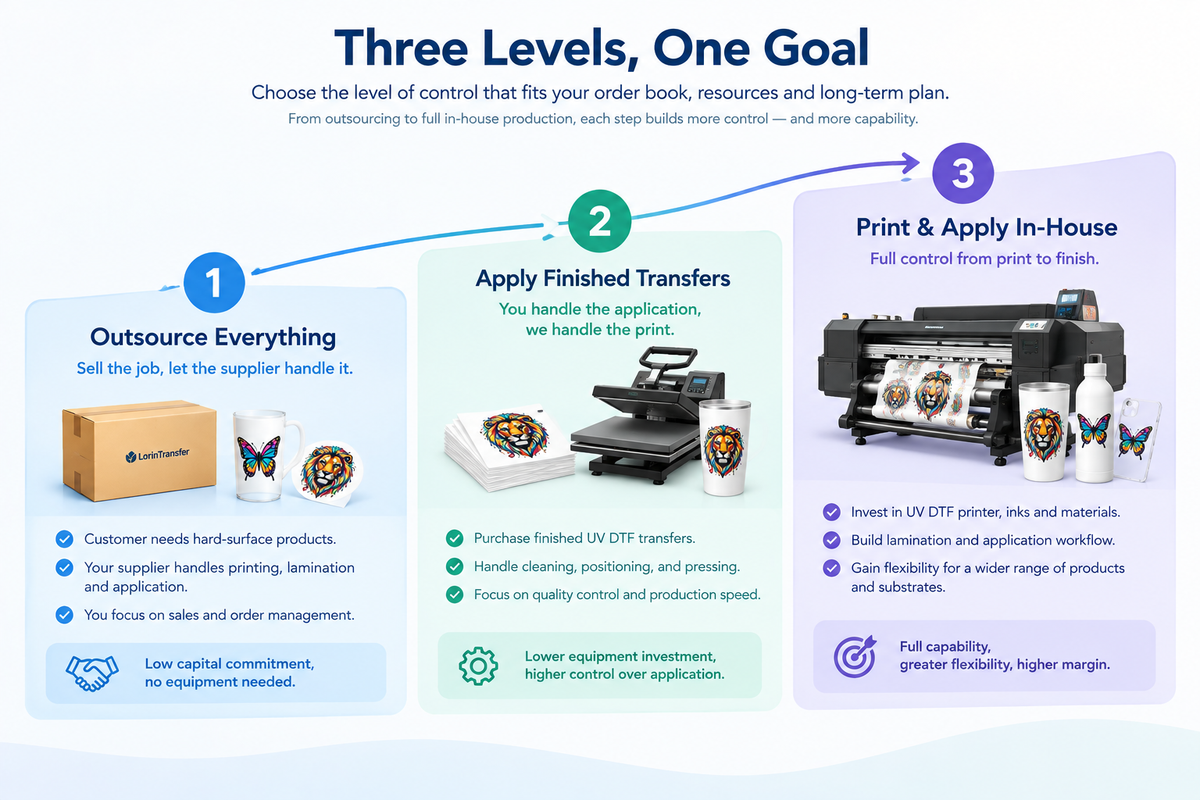
Level one — outsource the hard-surface jobs. You keep quoting hard-surface work and hand the printing to a supplier who already runs UV DTF, applying nothing yourself or applying only what the supplier ships ready to place. This costs you margin per job and gives you no control over turnaround or quality, but it also costs you nothing in equipment, staffing, or floor space. For a shop that is still measuring whether hard-surface demand is a trend or a blip, this is the level that answers the question for the least money. If you choose to outsource, what you are really buying is reliable finished work, and your whole selection problem reduces to finding that reliability.
Level two — do the application only. You buy finished UV DTF transfers — cup wraps and bottle labels among the common formats — and build the skill of applying them well, without buying a printer. This is the level most shops skip past, because the industry conversation jumps from "outsource it" to "buy a machine." It should not be skipped. Application is not a trivial step someone can pick up in an afternoon: the surface has to be clean and dry, the transfer has to be positioned correctly the first time because it cannot be repositioned, and the top film has to be peeled away without lifting the graphic. Buying finished work and mastering application lets a shop serve hard-surface customers, learn the real constraints of the process on its own terms, and decide about equipment later with actual experience behind the decision rather than a supplier's demonstration.
Level three — build the full line. You print the UV DTF transfer yourself and apply it in-house. This is the level that requires the dedicated machine, and the machine is a higher bar than "a UV printer." A UV DTF print line needs a white ink channel, a varnish or clear-coat channel, and integrated lamination — the layers that turn a printed image into a transferable, protected film. A general-purpose UV flatbed printer does not automatically have those, which is why "UV printer" and "UV DTF printer" are not the same piece of equipment. Before committing to this level, it is worth understanding what a new line actually costs to stand up, because the equipment is only part of it — floor space, ventilation, power, consumables, and the training time to run a second chemistry all belong in the same number.
The trigger conditions that move a shop between levels are behavioural, not numeric. Watch your order book for signals rather than thresholds: are customers now asking for hard-surface work unprompted, or did one job put the idea in your head? What share of your inquiries now include something that is not fabric, and how often are you declining or subcontracting that work? What does the mix look like — small, fast, high-variety hard-surface orders, or a steady repeat contract that would justify a line on its own? Do you have the floor space and the ventilation for a process that produces solvent-based odour and needs air handling? And critically, can the people who run your existing DTF line absorb a second, non-overlapping set of procedures, or does level three quietly mean a second trained operator? No single answer decides it. The level that fits is the highest one whose conditions you can already meet.
Running two systems in one shop without letting them damage each other
A shop at level three is running two production systems under one roof, and the two must be kept apart — not as a matter of tidiness, but because letting them touch is a hardware risk rather than a housekeeping one. The two chemistries do not merely produce different-looking prints; cross-contamination between them can damage equipment. Treat the separation below as risk control, not as optional good practice.
Ink path. Printheads, ink lines, dampers, capping stations, wiper blades, and peristaltic pumps must be dedicated to one chemistry each. This is the line where the stakes are highest, and it is why "one machine, two modes" is not a configuration option. Maintenance consumables belong here too: cleaning fluids and wipes should be assigned per system, because a wipe carrying residue from one chemistry can carry it into the other's ink path.
Consumables. UV ink and A/B film on one side; water-based ink, PET carrier film, and hot-melt powder on the other. These are not interchangeable even in storage, because their storage requirements differ — the two film types do not want the same conditions, and the powder has its own handling needs.
Workstations and floor space. UV DTF application is a cold, dry, hand operation at a bench. Standard DTF presses at a heat press or runs through a tunnel oven. These are different motions with different contamination sources, and keeping them physically separate prevents one process's dust, powder, or residue from wandering into the other's work area.
Training. The procedures that must not be confused are not just which ink goes in which machine. The one that catches people is repositionability: a standard DTF transfer can often be nudged after a light initial press, whereas a UV DTF transfer is effectively placed for good the moment it touches a clean surface. Two SOPs with a genuinely different rule on that point need to be trained as two SOPs, not blended into one mental model.
Damage attribution. Before the two systems share a shop, agree on how a mixed-up batch or a damaged printhead will be traced. If nobody has defined what counts as which system's fault, a contamination event becomes a disagreement instead of a diagnosis. Deciding the boundary in advance is the cheapest insurance in this entire setup.
If you are looking at your own order structure and cannot tell which of the three levels fits, that is the conversation we are set up to have — tell us what your hard-surface work looks like and we will help you place it on the ladder. LorinTransfer supplies UV DTF decals as finished products, so the hard-surface side of the comparison is something we can speak to directly, even though this article is deliberately not recommending one path over another.
The honest boundary: "UV DTF on fabric" is not what it sounds like
The fastest way to lose money with this technology is to believe that UV DTF means you can now decorate fabric without a heat press. That is not what it means, and the claim needs a careful answer rather than a flat yes or no.
There are two developments sometimes described as "UV DTF on fabric," and they are different things. One is a rigid, label-style transfer — a stiff patch that keeps its dimensional, plaque-like character — which is genuinely applied to fabric but is still, functionally, a hard part sitting on a soft surface. The other is an elastic formulation being explored specifically to flex and stretch with a garment, which is a different technical problem and is not at the same stage of maturity. Both are still maturing, and neither is a direct replacement for standard DTF on soft substrates. If you need decoration that flexes and washes with a garment, standard DTF is the process designed for that job; a UV DTF transfer with a stretch formulation is a separate, evolving option, not a substitute.
Because this boundary is so easy to blur, it is worth being explicit about what is outside this article: it will not diagnose cracks, lift-off, or adhesion failures for you, and it should not. If you are troubleshooting failed transfers on the textile side, the useful next step is to find which stage handed the defect to the next one, and that is a different article.
FAQ
Can a DTF printer run UV DTF ink?
Can UV DTF be applied to fabric?
Which is better, UV DTF or standard DTF?
Do you need a heat press for UV DTF?
How much does it cost to add a UV DTF line?
Contact Us
Tell us your requirements and our team will get back to you within 24 hours.

Ellen Lin
Product Manager & Heat Transfer Materials Specialist
Ellen Lin is a Product Manager at LorinTransfer, specializing in heat transfer materials, DTF printing solutions, and UV DTF transfer products. With hands-on experience in product development and market research, Ellen works closely with manufacturing teams and printing professionals to improve product performance, application methods, and customer solutions. She shares insights on transfer printing technologies, material selection, and industry trends to help businesses make better decisions for their printing projects.
Related Articles
How Long Do DTF Transfers Last, and What the Wash Count Is Measuring
DTF transfer wash durability means nothing without its test conditions. What counts as one wash cycle, how failure gets judged, and whether home or industrial standards apply.
DTF Film, Ink and Powder: Why the Problem You See Is Almost Never Where It Started
The film, ink and powder on a DTF line are three positions on one chain, and the hand-off between them decides what your press can do. When a transfer goes wrong, the symptom usually shows up far from where it started.
DTF Printing on Dark Fabrics: Isolate the Cause Before You Adjust Settings
A faded print on a black shirt usually gets worked on in one of two places: the heat press, or the white ink settings in the RIP.